Big news!
After 10 years, I've finally* gotten fed up with Blogger's lousy UI and ported this blog over to my personal website.
So you can real all new updates here. Starting with this one.
* well actually I've been fed up with the Blogger UI for a while …
Friday, January 10, 2020

Wednesday, December 4, 2019
The case to kill the Needham Line (and replace it with Rapid Transit)
Everything is interconnected.
That should be the lesson of any transportation infrastructure project. Everything moves together. One part is always related to another. A change to one piece of infrastructure may have effects—positive or negative—across modes, across time, and across a region. In some cases, a project in one area can have a major impact on a seemingly disparate project somewhere else. We can’t think of transportation projects in a silo; instead, we must think of everything is interrelated.
South Station Expansion: Supply vs Demand
Which brings me to the South Station Expansion (SSX) project. This behemoth is a decade-long (or more) project of dubious value. Of most value is rebuilding the Tower 1 interlocking, which, when it fails, has huge service impacts for the entirety of the south side Commuter Rail network, impacting tens of thousands of commuters. Of more cost, and less apparent benefit, are plans to buy the post office building and build more tracks at South Station. SSX poses the current capacity issues at South Station as a supply problem, and therefore sees the solution to build more supply. But what if, instead, we addressed the demand?
There are two ways to think of the demand at South Station, and how to mitigate it. One is to look at the time which it takes each train to platform, let passengers off the train, have the crew change from one end of the train to another and perform a brake test, and board passengers for the destination (the passenger movements and crew end change can happen simultaneously). Right now, at rush hour, there is a maximum of 20 Commuter Rail trains per hour at South Station, spread across 11 tracks used for Commuter Rail (the other two are used for Amtrak). This means that the average occupancy time of a track at South Station is 33 minutes.
This is not exactly good. At outlying terminals, trains frequently turn in as little as fifteen minutes; most Worcester Line trains, for example, spend 20 minutes or less from the time they arrive at an outlying terminal to the time they leave. Even taking into account higher passenger loads at the terminal station and the need to empty the train before refilling it (given the width of the platforms), as well as extra time to traverse Tower 1, something less than 33 minutes should be possible. Let’s assume that an average turn time of 25 minutes were feasible at South Station. This would allow 26 trains per hour to use the terminal’s 11 Commuter Rail tracks, a 30% increase over the current “capacity” without building a single new track.
There’s another way to look at SSX as a demand issue rather than a supply one: run fewer trains into the station. In most cases, this is a non-starter: the trains which run into the station are near or at capacity, so running fewer would cause more crowding and provide less service; even if longer trains were run where possible, they would be even more infrequent than the service provided today. There is an exception: the Needham Line could be replaced with rapid transit service and removed from South Station entirely, freeing up 10% of the capacity there without lifting a finger, at least on the Commuter Rail side. Reducing demand to preclude building more supply could save billions of dollars, and while converting the Needham Line to rapid transit wouldn’t be cheap, it might be significantly less expensive than South Station Expansion.
Needham Line Replacement
Other than the Fairmount Line, the Needham Line is Commuter Rail’s shortest. It runs less than 14 miles, splitting off of the Northeast Corridor at Forest Hills, running through Roslindale and West Roxbury to Needham Junction, and then curving back northeast to Needham Heights. (The track beyond there originally connected to what is now the Riverside Line.) The end of the line at Needham Heights is less than 10 miles, as the crow flies, from Downtown, closer, in fact, than the Green Line terminus at Riverside. Yet a train to South Station takes 46 minutes to complete the journey, making frequent stops between Needham and Forest Hills. Service is infrequent—about every 40 minutes—yet the line is still so crowded that it sometimes leaves passengers behind. This is probably because a typical rush hour commute time is even longer: the trip from Needham to Boston by car can take well over an hour.
This page recently detailed how a mile-long extension of the Orange Line to Melrose could, for a small investment, dramatically improve the service. Replacing the Needham Line would be a similar endeavor, albeit one at a larger scale. It would involve two line extensions, extending the Green Line south from Newton Highlands to Needham, and the Orange Line west from Forest Hills to West Roxbury. Most Needham Line riders would see slightly longer trip times to downtown Boston, but this would be made up for by dramatically-increase capacity, significantly shorter waiting times and much more frequent off-peak and weekend service (the Needham Line doesn’t operate on Sundays). It would also have cascading benefits throughout the regional transportation network.
Orange Line Extension to West Roxbury
Extending the Orange Line to West Roxbury would be a relatively simple project, as far as rail extensions go. Southwest of Forest Hills, the Orange Line terminates in a small, four-track yard, where trains can be stored temporarily at the end of the line. This yard happens to be adjacent to the Needham Line tracks, which extend to Roslindale and beyond. While it was originally a two-track right-of-way, the current Needham Line operates with a combination of single track and dual track, with most stations on the single track portion. Any conversion to rapid transit would require double-tracking of the line, which is generally easy in the existing right-of-way, except for two bridges in Robert and LaGrange streets, which have wide bridge abutments, but only a single trackway.
A trip to Back Bay station would take two or three minutes longer on the Orange Line than it does today on Commuter Rail, but rather than a train once every 40 minutes at rush hour and every two hours midday and Saturdays (and no service on Sundays), trains would come every few minutes, all day long. Given the current fare structure and the infrequency of service, many passengers would shift from taking a bus to Forest Hills and changing to the train there to a direct train trip, freeing up buses to be used on other routes in the region.
The largest cost in converting the line to rapid transit would be from the development of stations, which would generally have to be rebuilt with new platforms and vertical circulation, as few are ADA-compliant and some rely on pedestrian grade crossings, which are not feasible with third-rail power systems. The four new stations would replace the existing Commuter Rail stations, although it may be possible to consolidate the West Roxbury, Highland and Bellevue stations, which are less than half a mile from each other. The line may benefit from having a new station to the west near the VFW parkway. This would provide access to new housing developments there, the potential for a park-and-ride facility, and a station within walking distance of the VA medical center there, which is currently difficult to reach by transit and surrounded by a sea of parking. There are also several parcels of low-density strip malls which could be redeveloped as transit-oriented development (like this one), increasing ridership at the station as well as providing much-needed housing for the region. (There’s also a major electrical substation there, which would provide power to the line.)
West of there, there may be need for a small storage yard along the current right-of-way, especially if additional vehicles were needed to provide service (the Orange Line fleet as constructed today can barely keep up with current demand, but the new expanded fleet will allow more frequent service). The right-of-way across the river could be converted into a multi-use path, extending west across the Charles, through Cutler Park to Needham Junction, the Green Line extension, and the path southwest to Dover and beyond.
Why not extend the Orange Line further west? One is technology and the line’s profile: it would only be able to run as far as Needham Junction, north of which there are grade crossings incompatible with third rail electrification. It would require rebuilding three long bridges across the Charles, a drainage in Cutler Park and 128, which are currently single-tracked, and dealing with the current grade crossing in the golf course west of Hersey. But mostly, it’s because the population profile. The stations in Needham serve a much less dense population than those in Boston, and extending the Orange Line two miles across a park to serve Hersey and Needham Junction would be far more expensive than using the Green Line, which is needed in Needham because of the grade crossings there.
Green Line Extension to Needham
The outer portion of the Needham Line, from Needham Junction to Newton, looks very little like the line in West Roxbury. Today’s Needham Line is made up of three different railroads, a branch of the Boston and Providence to Dedham built in the 1840s, the Charles River Railroad built in the 1850s, and the portion between West Roxbury and Needham Junction, built in the early 1900s. While the B&P was grade-separated, the Charles River Railroad was not, and there are eight grade crossings between Needham Junction and Newton Highlands. This lends itself far more to a light-rail operation, with overhead power and smaller stations. Luckily, the Charles River Railroad split off the Boston and Albany’s Highland Branch at Newton Highlands, and the Highland Branch is today’s D Line.
Extending the D Line the first mile to Oak Street would be simple. The right-of-way is 85 feet wide, plenty wide enough for two Green Line tracks and the parallel Upper Falls Greenway (a 2017 document suggests there might be some areas which would require additional retaining walls, although the width of the corridor can easily accommodate two tracks). There are no grade crossings, existing mixed-use areas, and significant opportunities for further development in the corridor. The costliest item may be building a junction between the lines past Newton Highlands.
West of Oak Street is trickier, as bridges over both the Charles River and Route 128 would have to be widened and replaced. The bridge over the Charles is a single track, while the bridge over 128 was removed during the wildly expensive “add-a-lane” project (originally, the scope included rebuilding the bridge, but it was deleted out as a cost-saving move; although MassDOT would be responsible for restoring the bridge if the MBTA requested it, theoretically using highway funding; abutments are built to accommodate two tracks). From there, the right-of-way extends in to Needham, where it eventually joins up with the existing Commuter Rail line. Grade crossings would have to be added and power run (there is an existing substation adjacent to the line at the junction with the current D Line, as well as high voltage power at Needham Junction) and stations built, although grade-level, Green Line stations would be far less costly than those on the Orange Line, since they would consist of little more than concrete platforms and shelters. If retaining service to Hersey was desired, it could be served by a single-track extension from a terminal at Needham Junction (and theoretically, a single track Green Line would make more sense for a line from Needham to West Roxbury than Orange Line service, if service were desired along this leg).
The trip from Needham to Downtown Boston would be five to ten minutes longer than the Commuter Rail trip (more of an impact from Needham Junction and a minimal change from Needham Highlands), although improved Green Line fare payment and boarding may help speed trips on the line. There would be a major advantage for trips to the Longwood Medical Area, however, since the Longwood Green Line station would be just 25 to 30 minutes from Needham, and it is located significantly closer to the major employment center there than the Ruggles stop on the Commuter Rail is today. And, of course, trains would run every eight or ten minutes, as compared to the less-frequent Commuter Rail service today.
Since everything is interrelated, the biggest obstacle to this project may actually be the core capacity of the Green Line subway in Back Bay. From Copley to Park, there is a train every 90 seconds, which is close to the capacity of the line. While the MBTA has proposed adding longer vehicles to the line to increase capacity, adding a branch to Needham might overload the central subway system, even if service to each of the sub-branches (Needham and Riverside) were cut to every 8 to 10 minutes at rush hour, it would put more pressure on the line. There is, however, an escape valve. The design of the Kenmore station would allow some trains to terminate there, loop over the main trunk of the subway, and turn back outbound, without impact the Copley-Park segment. While this would incur a transfer for some passengers, they could board any other train in the station and continue their trip (and any passenger going to a destination west of Kenmore, like the LMA, would have no impact). This would allow service on the Riverside and Needham branches to maintain high frequencies without adding congestion downtown. (There are other solutions as well, but may be significantly more capital intensive than this, which would be free.)
Green Line Storage Capacity
A major benefit, however, would be the ability of the Needham extension to provide additional rail car storage for the Green Line. Once the Somverille Green Line extension opens, the line will need additional cars, and if the fleet is upgraded from 75-foot cars to 100-foot cars, as is proposed, the current storage facilities will be unable to cope with the number of cars on the line. (Of course, if service were run 24 hours each day, enough cars would be operating on the line as to reduce the need for more storage.) Cars are currently stored at Riverside, Reservoir, Lake Street (at the end of the B Line) and at Lechmere. The Lechmere yard will be replaced with a new facility as part of the Green Line extension project, but there are otherwise few areas to expand train storage, and the Needham Branch would require more cars, and more storage.
Needham Junction, however, provides that room. The current Riverside yard provides storage for 6000 linear feet of railcars, which accounts for about half of the space in the yard (the rest is the T’s heavy maintenance facility for the Green Line). Needham Junction could easily accommodate that size of facility (see a comparison here) and, if expanded to fill out the wye there and the adjacent power line right of way could store triple the amount, enough to store the entire current fleet (including the forthcoming Type 9s), so certainly enough to provide additional capacity for future fleet needs. Part of the site could also be used as a park-and-ride lot or for transit-oriented development (the portion not already owned by the T is owned by a landscaping company).
Overall Benefits
Extending the Green and Orange lines to Needham and West Roxbury would be a major undertaking: a multi-year project which would cost hundreds of millions of dollars. And yet, its effects would be felt far outside of Needham and West Roxbury. It would provide:
That should be the lesson of any transportation infrastructure project. Everything moves together. One part is always related to another. A change to one piece of infrastructure may have effects—positive or negative—across modes, across time, and across a region. In some cases, a project in one area can have a major impact on a seemingly disparate project somewhere else. We can’t think of transportation projects in a silo; instead, we must think of everything is interrelated.
South Station Expansion: Supply vs Demand
Which brings me to the South Station Expansion (SSX) project. This behemoth is a decade-long (or more) project of dubious value. Of most value is rebuilding the Tower 1 interlocking, which, when it fails, has huge service impacts for the entirety of the south side Commuter Rail network, impacting tens of thousands of commuters. Of more cost, and less apparent benefit, are plans to buy the post office building and build more tracks at South Station. SSX poses the current capacity issues at South Station as a supply problem, and therefore sees the solution to build more supply. But what if, instead, we addressed the demand?
There are two ways to think of the demand at South Station, and how to mitigate it. One is to look at the time which it takes each train to platform, let passengers off the train, have the crew change from one end of the train to another and perform a brake test, and board passengers for the destination (the passenger movements and crew end change can happen simultaneously). Right now, at rush hour, there is a maximum of 20 Commuter Rail trains per hour at South Station, spread across 11 tracks used for Commuter Rail (the other two are used for Amtrak). This means that the average occupancy time of a track at South Station is 33 minutes.
This is not exactly good. At outlying terminals, trains frequently turn in as little as fifteen minutes; most Worcester Line trains, for example, spend 20 minutes or less from the time they arrive at an outlying terminal to the time they leave. Even taking into account higher passenger loads at the terminal station and the need to empty the train before refilling it (given the width of the platforms), as well as extra time to traverse Tower 1, something less than 33 minutes should be possible. Let’s assume that an average turn time of 25 minutes were feasible at South Station. This would allow 26 trains per hour to use the terminal’s 11 Commuter Rail tracks, a 30% increase over the current “capacity” without building a single new track.
There’s another way to look at SSX as a demand issue rather than a supply one: run fewer trains into the station. In most cases, this is a non-starter: the trains which run into the station are near or at capacity, so running fewer would cause more crowding and provide less service; even if longer trains were run where possible, they would be even more infrequent than the service provided today. There is an exception: the Needham Line could be replaced with rapid transit service and removed from South Station entirely, freeing up 10% of the capacity there without lifting a finger, at least on the Commuter Rail side. Reducing demand to preclude building more supply could save billions of dollars, and while converting the Needham Line to rapid transit wouldn’t be cheap, it might be significantly less expensive than South Station Expansion.
Needham Line Replacement
Other than the Fairmount Line, the Needham Line is Commuter Rail’s shortest. It runs less than 14 miles, splitting off of the Northeast Corridor at Forest Hills, running through Roslindale and West Roxbury to Needham Junction, and then curving back northeast to Needham Heights. (The track beyond there originally connected to what is now the Riverside Line.) The end of the line at Needham Heights is less than 10 miles, as the crow flies, from Downtown, closer, in fact, than the Green Line terminus at Riverside. Yet a train to South Station takes 46 minutes to complete the journey, making frequent stops between Needham and Forest Hills. Service is infrequent—about every 40 minutes—yet the line is still so crowded that it sometimes leaves passengers behind. This is probably because a typical rush hour commute time is even longer: the trip from Needham to Boston by car can take well over an hour.
This page recently detailed how a mile-long extension of the Orange Line to Melrose could, for a small investment, dramatically improve the service. Replacing the Needham Line would be a similar endeavor, albeit one at a larger scale. It would involve two line extensions, extending the Green Line south from Newton Highlands to Needham, and the Orange Line west from Forest Hills to West Roxbury. Most Needham Line riders would see slightly longer trip times to downtown Boston, but this would be made up for by dramatically-increase capacity, significantly shorter waiting times and much more frequent off-peak and weekend service (the Needham Line doesn’t operate on Sundays). It would also have cascading benefits throughout the regional transportation network.
Orange Line Extension to West Roxbury
Extending the Orange Line to West Roxbury would be a relatively simple project, as far as rail extensions go. Southwest of Forest Hills, the Orange Line terminates in a small, four-track yard, where trains can be stored temporarily at the end of the line. This yard happens to be adjacent to the Needham Line tracks, which extend to Roslindale and beyond. While it was originally a two-track right-of-way, the current Needham Line operates with a combination of single track and dual track, with most stations on the single track portion. Any conversion to rapid transit would require double-tracking of the line, which is generally easy in the existing right-of-way, except for two bridges in Robert and LaGrange streets, which have wide bridge abutments, but only a single trackway.
A trip to Back Bay station would take two or three minutes longer on the Orange Line than it does today on Commuter Rail, but rather than a train once every 40 minutes at rush hour and every two hours midday and Saturdays (and no service on Sundays), trains would come every few minutes, all day long. Given the current fare structure and the infrequency of service, many passengers would shift from taking a bus to Forest Hills and changing to the train there to a direct train trip, freeing up buses to be used on other routes in the region.
The largest cost in converting the line to rapid transit would be from the development of stations, which would generally have to be rebuilt with new platforms and vertical circulation, as few are ADA-compliant and some rely on pedestrian grade crossings, which are not feasible with third-rail power systems. The four new stations would replace the existing Commuter Rail stations, although it may be possible to consolidate the West Roxbury, Highland and Bellevue stations, which are less than half a mile from each other. The line may benefit from having a new station to the west near the VFW parkway. This would provide access to new housing developments there, the potential for a park-and-ride facility, and a station within walking distance of the VA medical center there, which is currently difficult to reach by transit and surrounded by a sea of parking. There are also several parcels of low-density strip malls which could be redeveloped as transit-oriented development (like this one), increasing ridership at the station as well as providing much-needed housing for the region. (There’s also a major electrical substation there, which would provide power to the line.)
West of there, there may be need for a small storage yard along the current right-of-way, especially if additional vehicles were needed to provide service (the Orange Line fleet as constructed today can barely keep up with current demand, but the new expanded fleet will allow more frequent service). The right-of-way across the river could be converted into a multi-use path, extending west across the Charles, through Cutler Park to Needham Junction, the Green Line extension, and the path southwest to Dover and beyond.
Why not extend the Orange Line further west? One is technology and the line’s profile: it would only be able to run as far as Needham Junction, north of which there are grade crossings incompatible with third rail electrification. It would require rebuilding three long bridges across the Charles, a drainage in Cutler Park and 128, which are currently single-tracked, and dealing with the current grade crossing in the golf course west of Hersey. But mostly, it’s because the population profile. The stations in Needham serve a much less dense population than those in Boston, and extending the Orange Line two miles across a park to serve Hersey and Needham Junction would be far more expensive than using the Green Line, which is needed in Needham because of the grade crossings there.
Green Line Extension to Needham
The outer portion of the Needham Line, from Needham Junction to Newton, looks very little like the line in West Roxbury. Today’s Needham Line is made up of three different railroads, a branch of the Boston and Providence to Dedham built in the 1840s, the Charles River Railroad built in the 1850s, and the portion between West Roxbury and Needham Junction, built in the early 1900s. While the B&P was grade-separated, the Charles River Railroad was not, and there are eight grade crossings between Needham Junction and Newton Highlands. This lends itself far more to a light-rail operation, with overhead power and smaller stations. Luckily, the Charles River Railroad split off the Boston and Albany’s Highland Branch at Newton Highlands, and the Highland Branch is today’s D Line.
Extending the D Line the first mile to Oak Street would be simple. The right-of-way is 85 feet wide, plenty wide enough for two Green Line tracks and the parallel Upper Falls Greenway (a 2017 document suggests there might be some areas which would require additional retaining walls, although the width of the corridor can easily accommodate two tracks). There are no grade crossings, existing mixed-use areas, and significant opportunities for further development in the corridor. The costliest item may be building a junction between the lines past Newton Highlands.
West of Oak Street is trickier, as bridges over both the Charles River and Route 128 would have to be widened and replaced. The bridge over the Charles is a single track, while the bridge over 128 was removed during the wildly expensive “add-a-lane” project (originally, the scope included rebuilding the bridge, but it was deleted out as a cost-saving move; although MassDOT would be responsible for restoring the bridge if the MBTA requested it, theoretically using highway funding; abutments are built to accommodate two tracks). From there, the right-of-way extends in to Needham, where it eventually joins up with the existing Commuter Rail line. Grade crossings would have to be added and power run (there is an existing substation adjacent to the line at the junction with the current D Line, as well as high voltage power at Needham Junction) and stations built, although grade-level, Green Line stations would be far less costly than those on the Orange Line, since they would consist of little more than concrete platforms and shelters. If retaining service to Hersey was desired, it could be served by a single-track extension from a terminal at Needham Junction (and theoretically, a single track Green Line would make more sense for a line from Needham to West Roxbury than Orange Line service, if service were desired along this leg).
The trip from Needham to Downtown Boston would be five to ten minutes longer than the Commuter Rail trip (more of an impact from Needham Junction and a minimal change from Needham Highlands), although improved Green Line fare payment and boarding may help speed trips on the line. There would be a major advantage for trips to the Longwood Medical Area, however, since the Longwood Green Line station would be just 25 to 30 minutes from Needham, and it is located significantly closer to the major employment center there than the Ruggles stop on the Commuter Rail is today. And, of course, trains would run every eight or ten minutes, as compared to the less-frequent Commuter Rail service today.
Since everything is interrelated, the biggest obstacle to this project may actually be the core capacity of the Green Line subway in Back Bay. From Copley to Park, there is a train every 90 seconds, which is close to the capacity of the line. While the MBTA has proposed adding longer vehicles to the line to increase capacity, adding a branch to Needham might overload the central subway system, even if service to each of the sub-branches (Needham and Riverside) were cut to every 8 to 10 minutes at rush hour, it would put more pressure on the line. There is, however, an escape valve. The design of the Kenmore station would allow some trains to terminate there, loop over the main trunk of the subway, and turn back outbound, without impact the Copley-Park segment. While this would incur a transfer for some passengers, they could board any other train in the station and continue their trip (and any passenger going to a destination west of Kenmore, like the LMA, would have no impact). This would allow service on the Riverside and Needham branches to maintain high frequencies without adding congestion downtown. (There are other solutions as well, but may be significantly more capital intensive than this, which would be free.)
Green Line Storage Capacity
A major benefit, however, would be the ability of the Needham extension to provide additional rail car storage for the Green Line. Once the Somverille Green Line extension opens, the line will need additional cars, and if the fleet is upgraded from 75-foot cars to 100-foot cars, as is proposed, the current storage facilities will be unable to cope with the number of cars on the line. (Of course, if service were run 24 hours each day, enough cars would be operating on the line as to reduce the need for more storage.) Cars are currently stored at Riverside, Reservoir, Lake Street (at the end of the B Line) and at Lechmere. The Lechmere yard will be replaced with a new facility as part of the Green Line extension project, but there are otherwise few areas to expand train storage, and the Needham Branch would require more cars, and more storage.
Needham Junction, however, provides that room. The current Riverside yard provides storage for 6000 linear feet of railcars, which accounts for about half of the space in the yard (the rest is the T’s heavy maintenance facility for the Green Line). Needham Junction could easily accommodate that size of facility (see a comparison here) and, if expanded to fill out the wye there and the adjacent power line right of way could store triple the amount, enough to store the entire current fleet (including the forthcoming Type 9s), so certainly enough to provide additional capacity for future fleet needs. Part of the site could also be used as a park-and-ride lot or for transit-oriented development (the portion not already owned by the T is owned by a landscaping company).
Overall Benefits
Extending the Green and Orange lines to Needham and West Roxbury would be a major undertaking: a multi-year project which would cost hundreds of millions of dollars. And yet, its effects would be felt far outside of Needham and West Roxbury. It would provide:
- Much more frequent service for Needham, West Roxbury and Roslindale commuters
- More capacity at an unexpanded South Station, to add service to other Commuter Rail lines, and the ability to push back the huge expenditure required to add capacity to South Station
- Additional “slots” on the Northeast Corridor, to allow more service on this particularly-constrained portion of the Commuter Rail.
- Additional storage for Green Line trains
- More bus service in the entire region, since many of the bus routes currently serving Forest Hills could be reduced in frequency (given the Orange Line in West Roxbury) and cut back from Forest Hills to Roslindale or other Orange Line stations. The buses saved could be reallocated to other parts of the system. In addition, the 59 bus in Newton and Needham could be truncated and replaced with the Green Line.
- The reallocation of the three Needham Line Commuter Rail train sets, which would add capacity to the rest of the system and/or allow some of the most antiquated trains to be retired.
- A new greenway path connecting the ends of the Orange and Green line extensions to Cutler and Millennium Parks, across the Charles River, and south and west to Needham Town Forest and parks and conservation areas beyond.
Friday, November 22, 2019
Ari and Miles rate Boston Magazine's "40 Ideas"
It’s transportation week here in Boston, apparently, what with the Globe Spotlight series dropping and Boston Magazine publishing their list of 40 ideas for transportation.
I started reading the 40 ideas piece and with each one had a reaction. Mostly “yeah,” “mm-hmm,” or “what, are you out of your goddamn mind?” Then I realized: I should rate these. On a scale of 1 to 10. On my blog. Because who wouldn’t want to read one person’s ranting about other people’s ideas, rated on a 1 to 10 scale.
Well, a lot of people. But what if … two people each rated the ideas, on a 1 to 10 scale. That’s a little more interesting. Certainly more fun to read. And when I think of rating transportation on a 1 to 10 scale, I think of one person: Miles “Miles on the MBTA” Taylor (well, now that he’s in undergrad in Philly, he’s going by “Miles in Transit” but we know where his loyalties lie.)
That’s right: guest co-blogging this post is the one and only Miles on the MBTA.
GET EXCITED. Set your snark detector to high.
A few notes before we dive in. First, these are listed in the order they appeared in the Boston Magazine story (on several different pages), not based on our rankings (so you don’t have to jump around, note that the magazine has the ideas grouped by mode, and I'll link to each page). I set some ground rules: points for (or against) creativity, feasibility, is it a “big” idea, and not “staying in your lane,” i.e. if someone works for an organization which advocates for x, and their proposal is to do x, it’s not as exciting. Also, it's worth noting that Miles wrote his ratings and responses without looking at mine.
So, we’re off. Thanks, Miles! And somehow this is under 4000 words (I should stop typing!).
Group 1: Cars
1. Congestion modeling as an investment (John Fish)
Ari: 9. Good idea, coming from a business leader. Good framing. One question: what do we do with the money? Does it go all towards transit? What if it was just put in an account and divided by the number of people in the state and returned as a tax rebate a la Canada’s carbon tax? Is this a good idea? How do we implement?
Miles: 8. Congestion pricing is awesome and Boston needs to do it. My one qualm: it’s really tough to find alternate, non-driving ways of commuting from low-income gateway cities like Brockton or Lawrence when the Commuter Rail is so inadequate. There could be equity issues here.
2. Tax garage parking (Ari!)
Ari: 10. Perfect. Do it. (But actually, a good idea, lots of precedent elsewhere, and, yeah, I’m going outside my usual transit “lane.”)
Miles: 10. Ew, Ari Ofsevit wrote this one—I can’t stand that guy. But seriously, this is a no-brainer, and every other major city has done it already.
3. Be less of a Masshole (Kenny Young)
Ari: 4. Fine idea, but doesn’t really do much. Sure, calming down is good. Looking at photos on your phone, however … demerits for that.
Miles: 3. Um, okay. Seems pretty fluffy to me. And aside from the phone use while driving (which doesn’t seem like a great way to “save transportation”), the bit about “singing at the top of your lungs” perpetuates the fact that it’s just you and your car—i.e. the geometry problem that got us into this mess in the first place. I like his title, though: “Personal driver, Kenny’s car.” That’s pretty funny.
4. Make drivers suffer (Sue O’Connell)
Ari: 9. Yes! Pedestrianization! Make it hard to drive! Although free transit is fraught.
Miles: 8. Pretty much a grander version of number 1, and it sounds amazing. I love the idea of having a city as painful to drive in as Amsterdam. O’Connell even addresses the potential equity problems with higher fees for having cars. It’s a lot, though, and pretty much a utopian vision with the current administration.
5. Late night transit (Garrett Harker)
Ari: 8. Make Boston more of a late night city? Great. Transit for late night employees? Great. Doing this through TNCs? Not sure what happens when they have to make money someday.
Miles: 6. Yeah, it would be nice to live in a city that doesn’t go to bed at 8 PM. Using a more vibrant nightlife to fuel 24-hour transit is an interesting idea, but I think the latter has to come before the former. And while it’s neat that he partnered with Lyft to get his workers home cheaply, early-morning MBTA buses get too packed to do something similar for them.
6. Autonomous cars for all (Lee Pelton)
Ari: 1. Can I go to zero? Can I go negative? Give me a break. We can all ride in an autonomous car driving around the city because there’s so much room on our roads. Seriously, Emerson? Has this guy ever looked out the window? Autonomous cars are cars. Cars in the city are bad. Please. I’ll keep him at 1 because at least he admits this is decades away.
Miles: 1. A Celtics game at TD Garden lets out. You have 20,000 people trying to get home. As the line of 20,000 individuals vehicles gets backed up along Causeway Street (and Commercial Street, and Atlantic Ave, etc. etc. etc.) waiting to pick everyone up, those autonomous cars suddenly don’t look so efficient, do they? What a shame.
7. Smarter tolls (Chris Dempsey)
Ari: 8. Good idea, should be implemented, but points off for staying too much in your lane. In other words, we know what to do? Now, how do we do it?
Miles: 9. It’s very much inside the box, but using existing infrastructure to cheaply instate congestion pricing is a great idea. The Tobin Bridge is a good place to try it, but the plan should come with a bus lane for the 111—goodness knows it needs it.
8. Fix potholes (Ernie Boch, Jr)
Ari: 2. If you don’t like potholes, move to Arizona or somewhere that doesn’t have freeze thaw cycles. Or start paying more for the roads, you Trump-loving sycophant.
Miles: 2. Are the potholes ruining your beautiful expensive cars? I’m playing the world’s smallest violin for you. Not a 1 because buses drive on the roads too, so at least they would benefit too.
9. Get cars off the road (Kristen Eck)
Ari: 10. Simple, and coming from the traffic reporter. More people without more roads = more traffic.
Miles: 6. It’s a good mindset to have, but the implementation is really vague and doesn’t do anything to fix the alternatives to driving. Sure, we can subsidize MBTA passes for employees, but if the Red Line breaks down for the 15th time that week, how valuable will those passes look?
10. Worcester-to-Boston (Mary Connaughton)
Ari: 8. Fixing the Turnpike outside of Allston is a good idea. But fixing the Worcester Line would do a lot more. People on Twitter think this could be done with toll revenue. Both, and?
Miles: 6. Kind of a mishmash of ideas here, some good, some bad. Improving Worcester Line service is a no-brainer, but keep the added service going past the time of construction, unlike what this entry seems to suggest. Fixing the monstrosity known as Newton Corner, fantastic. Increasing parking at Commuter Rail stations...fine at some of the more middle-of-nowhere ones, I guess. But building I-90 at grade just to make the project go faster? Hope you like diesel fumes!
11. Fix signage (Scott Ferson)
Ari. 2. This guy doesn’t seem to like the MUTCD. He rails against control cities. And he doesn’t understand that the exit number sign already indicates whether an exit is a left-hand exit or not. Not sure what this would do for congestion even if it made him feel better.
Miles: 3. I mean … whatever, man. Massachusetts has its share of crazy signs, but a lot of this comes down to the insane interchanges rather than problems with the signage itself. I’m not against the idea, per se, but its inclusion just feels like filler.
12. Give commercial vehicles more space (Ana Cristina Fragoso)
Ari: 5. Sort of a fine idea, I guess. More and better loading zones would make sense. Moving some stuff to rail? Fine. Ferries? Meh. More important are probably local loading zones, and getting people to stop ordering stupid shit from Amazon Prime and getting single rolls of toilet paper delivered by cars. We need a bit less Veruca Salt ("Don’t care how, I want it now!") syndrome and a bit more walking half a mile to the corner store.
Miles: 5. Points for being a unique consideration (it’s not something I’ve ever thought about). I like the idea of focusing on other ways of getting freight into the city, although it is going to be a tough sell to dedicate entire roads to commercial vehicles.
13. End distracted driving (The Rev Laura Everett)
Ari: 10. Yes! Put your goddamn phone away. Not out of your hand. Not a glowing rectangle next to your face. No. Away-away. In the glove box until you get to your destination. Look at the directions before you start driving, like we used to do before we had phones. If you don’t know where you are going, you shouldn’t be on the road.
Miles: 8. Yeah, okay, let’s do it! This is by no means groundbreaking, but any way to eliminate pedestrian deaths is a good thing.
Group 2: Buses
14: BRT (Julia Wallerce)
Ari: 8. BRT is great, but a) not going to solve all of our problems, and b) very much in Julia’s lane. But, yeah, put in some goddamn bus lanes already.
Miles: 8. BRT is a fantastic way to improve capacity in Boston’s overcrowded bus system. While this is a rosy look (how many Boston streets are wide enough for center-running BRT?), it’s still a great system to strive for.
15. Better interior bus design (Zuleny Gonzales)
Ari: 10. I was on the 70 and an already late-and-full bus was delayed several minutes while the driver helped a mobility-impaired person safely board. Plus the driver had to deploy the ramp by hand because it was broken. Making buses work better for people with mobility issues makes buses work better for everyone (goes for trains, too).
Miles: 10. Absolutely needed. If we can make riding the bus easier for everyone, especially those who are disabled, then not only will more of those riders take the bus, but speeds will be increased—I can’t be the only one who internally groans when someone in a wheelchair gets on and I know we’ll have to endure the two-minute strap-in process. It’s not the person’s fault, it’s the vehicle design.
16. Make way for buses (Jarrett Walker)
Ari: 8. Bus lanes and bus lane enforcement. Not a bad idea at all. Getting the police to care, though …
Miles: 10. I’m not a Jarrett Walker fanboy, I swear! Seriously, though, bus lanes are sorely needed in this city, along with proper enforcement. It’s definitely inside the box, and many bus lane projects are already happening, but there’s no denying that if we want to fix Boston’s bus problem, bus lanes are objective number 1.
17. Blue Hill Ave buses (Quincy Miller)
Ari: 10. Blue Hill Ave is the top corridor in the state for BRT. Tear out the concrete medians, put in BRT, and plant some trees.
Miles: 10. This is one of the only corridors where the treatment in number 16 would work. Plus, the 28 is the MBTA’s highest-ridership bus route—what better place for a BRT line? Redundant to the others, but I can’t argue with true BRT on Blue Hill Ave.
Group 3: Rail
18. Electrification (Adam Gaffin)
Ari: 10. Adam gets it.
Miles: 10. Everyone knows this is sorely needed. It’s been talked about to death already, and it seems like the only people holding back are those up at the top. Let’s do it.
19. Build the Grand Junction (C.A. Webb)
Ari: 10. The Grand Junction is the best ROI for a rapid transit “crosstown” link. North Station-"Cambridge Crossing"–East Cambridge–Kendall–Cambridgeport–Allston. It doesn’t sound like a busy transit line today, but with ongoing development, that order of stations may soon read something more like North Station–Kendall–Kendall–Kendall–Kendall–Harvard (Allston). With the Allston project, the time to do this is now.
Miles: 8. More transit to Kendall Square is really important, and the Grand Junction is the only existing rail asset there besides the Red Line. I’ve never been a giant fan of the whole “run Worcester trains via the Grand Junction to North Station” thing, though—you end up with a reverse-branch that could potentially limit the number of trains serving South Station. Instead, how about a frequent shuttle from Allston to North Station?
20. Gondola!!!1! (Roger Berkowitz)
Ari: 1. Bus lane!!!1! (Or if you want a subway, put trains in the Silver Line tunnel. Remember, the gondola doesn’t work just because you say words.)
Miles: 1. THE SEAPORT GONDOLA IS BACK!!!!!! Look, we have a "subway tunnel service" to the Seaport—it’s the Silver Line, and yes, it is insanely overcrowded at rush hour. Convert it to light rail and suddenly you’re going to see a lot more capacity for that "subway tunnel service." And reopen the Northern Ave Bridge for car traffic? Ever heard of induced demand?
21. Big rail (Kathryn Carlson)
Ari: 10. Yes, regional rail! And let’s remember, those cost estimates are … high. But $30 billion (less, though, because this includes the cost of buying rolling stock, which the T has to do no matter what propulsion system is used) over the next 10 years is $600 per person per year inside of 495, much of which you could get from the feds, to completely transform the regional transportation system. It’s really not that much.
Miles: 10. Another one that’s been talked to death, and pretty much every transit advocate agrees this needs to be done. Carlson even brings up the hefty cost and defends it.
22. Better PR (Max Grinnell)
Ari: 4. I mean, better PR would be nice, but it won’t make the trains run on time.
Miles: 2. I don’t think Max Grinnell reads the MBTA’s Twitter replies. When they’re stuck in a line of trains trapped behind a broken signal, people don’t feel any better by looking at cutesy PSAs. I guess it’s a nice thought, but it’s nothing more than that: a nice thought.
23. Widett transportation hub (Tom Tinlin)
Ari: 2. Oh, it’s Track 61 again. Like the gondola, it also still doesn’t work just because your mouthparts move.
Miles: 2. Points for originality, but I’m not quite sure what the goal is here. "A Widett Circle station could let commuter-rail passengers from the southeast get to Back Bay or Ruggles without going all the way to South Station." What? How? Track 61, I guess? And Tinlin talks about connecting the Red Line and Commuter Rail here. So there’d be a new Red Line subway station? With a 700-foot connection from Dot Ave to a new Commuter Rail station? This had better coincide with a redevelopment of the area, or else you’re going to end up with a lot of wasted money.
Group 4: Bikes
24: Franklin Park Bike Hub (Elijah Evans)
Ari: 7. This would be great, having Franklin Park be more usable by bicycles (and overall, some of the paths there are overgrown, it’s kind of weird). And I do like the idea of making roads nearby more bike-friendly. But it’s not going to solve the regional transportation issue, even if it helps some.
Miles: 7. This seems like mostly a PR campaign to make local residents more aware of the ease of biking through Franklin Park, which is not a bad thing. Importantly, though, it would have to come with better bike infrastructure on surrounding roads—the park itself isn’t really gonna get you anywhere.
25. Bike the last mile (David Montague)
Ari: 6. A fine idea, although congestion isn’t always the last mile. This is also very much in the lane for David Montague, who owns a folding bike company.
Miles: 4. A novel concept for sure. But think about a cold winter day: you’re in your warm car, and you come to the “park-and-bike” lot—do you really want to get out of your private vehicle and get on your freezing bike through the pounding snow instead? Probably not. This isn’t a problem with a typical transit-based park-and-ride system.
26. Share the road (Jenny Johnson)
Ari: 9. Give bicycles better facilities and they’ll be more law abiding? Yup. Go to Europe and see how design begets ridership? Sure.
Miles: 10. Johnson’s anecdote about bikers waiting at the light in Vienna really drives home the idea that people will follow the rules when they’re fair. In Boston, bikers get so little compared to cars—of course they’re going to rebel and run the light. Give bikers the safe corridors they need, and you’ll see a lot more harmony on our roads.
27. Helmets for Hubway (Joanne Chang)
Ari: 3. I mean, fine, but helmets don’t keep people from riding BlueBikes. In fact, these upright, Dutch-style, stable bikes are probably the ones with the least need for helmets. This does basically nothing. (I’m surprisingly libertarian on bike helmets.)
Miles: 3. No one wears helmets in Amsterdam, because bike fatalities are ridiculously low, because the streets are designed for them. While helmets may make you feel safer here, they’re not doing anything to actually solve the transportation problem for bikers.
28. Connect the paths (Juliet Eldred)
Ari: 10. NUMTOT! But even if it wasn’t NUMTOT-in-chief @drooliet, it’s also a great idea. The real last mile issue with bikes (see above) is that the last mile of a bike trip is often unsafe. So people drive. Let’s cover the city with a web of bike lanes, instead of traffic lanes.
Miles: 10. As a proud NUMTOT, it is so cool to see that Juliet made the cut here. And her idea makes so much sense: why do we have these fancy separated bike lanes that connect to lines of paint on the road? We can’t wave a magic wand and instantaneously get separated bike lanes on every street in the city, but we can at least try to connect the ones we have.
Group 5: Other
29. Podcars (Bill James)
Ari: 1. No.
Miles: 1. Aahgahgaghhhghhh.
30. Road diets (Joe Curtatone)
Ari: 9. Yes. Now, can you call over to Marty and get Boston to stop shitting all over this?
Miles: 10. Putting aside the fantastic points, ideas, and examples put forth here, it’s amazing to see that this was written by an elected official, the mayor of Somerville. It gives me hope that there are people on the top who know what’s going on and want to fix it.
31. Flying cars! (Gwen Lighter)
Ari: 1. Also no. Not as crazy as podcars because they aren’t low-capacity elevated railroads, but has anyone talked to the FAA about this?
Miles: 1. What? Is this a joke? Am I reading an Onion article?
32. Fare equity (Tanisha Sullivan)
Ari: 8. Fare equity is great. Implementation is, well, not as easy. Price discrimination allows us to do things like keeping certain services from being even more overrun when they are already near capacity. Without this, we get a tragedy of the commons with poor service and long wait times like, well, like the roads at rush hour. (Off-peak pricing, now, there's an idea!)
Miles: 7. This is a good, moderate look at how to improve access for people. Free MBTA fares for students and seniors is more realistic than making the whole system free, while encouraging flexible work hours would ease rush hour traffic a bit. Nothing groundbreaking here, but some fine ideas.
33. Ferries (Alice Brown)
Ari: 5. Ferries are useful for a few demand corridors, but not really a game-changer regionally. And this is very in-her-lane for the head of Boston Harbor Now.
Miles: 4. Utilizing our water assets and creating new ferry routes is good in theory, but who’s taking a ferry from East Boston to Long Wharf when the Blue Line exists? Maybe the people in the expensive luxury homes near the water, but not much else. East Boston to the Seaport is better, but even then, bus lanes in the Ted Williams for the SL3 would help here, too. I just don’t want Boston to end up with a repeat of the NYC Ferry http://secondavenuesagas.com/2019/10/06/its-time-to-stop-subsidizing-the-nyc-ferry-fares/.
34. Think outside the box (Jim Canales)
Ari: 7. Let’s be a world class city with outside the box ideas is fine, but vague.
Miles: 7. This is vague as heck, but the general call to [waves hand] think outside the box is solid.
35. Dockless scooters! (Lama Bou Mjahed)
Ari: 2. Small-wheeled death traps which are expensive and still lose money. Pass.
Miles: 2. This is listed under "Big Ideas"? Dockless bikes and scooters are already being implemented around the country, and even in the Boston region! It might take a few (a few) cars off the road, but this isn’t the big solution we’re looking for. And Bluebikes already has great coverage that’s expanding.
36. Robotaxis (Karl Iagnemma)
Ari: 1. Hooray, more cars! Using technology we don’t have! Magic!
Miles: 2. Okay … I guess it’s not hyping these things as a full-on takeover, but rather a low-cost last-mile solution that’s apparently being implemented in Vegas already. One point added for being realistic.
37. Teamwork (Patrick Sullivan)
Ari: 7. Getting people together is great. But as the Globe points out, if they are all subsidizing driving, it doesn’t help that much.
Miles: 6. Working with companies to open up new transportation options...okay, I can roll with that. But the example of the North Station/Seaport Ferry shows the flip side of it: it’s great for members of participating companies, but for members of the public, the ferry is near-unknown, and you can only buy tickets online in advance. These partnerships need to ensure that the public can benefit as well, not just the private companies involved.
38. Listen to users (Ambar Johnson)
Ari: 8. Not necessarily a big idea, but having a better way to have public feedback with the agency and cities and towns, especially outside of public meetings attended by old white people, would be good.
Miles: 10. I mean … it’s probably the least revolutionary idea on here, but it’s also one of the most obvious. The users know best, and the piece summarizes it well: "Listen and trust their judgement, and just implement it."
39. Invest in Gateway Cities (Tracey Corley)
Ari: 9. Yes. Gateway cities are an opportunity to build more housing near transit, and build more walkable, livable areas people want to live. Millennials don’t necessarily want to be in Boston (or Cambridge, or Somerville) but to live in a walkable, urban community with amenities and good transit. Gateway Cities provide this opportunity.
Miles: 8. The idea of gateway cities being self-contained, you know, cities that are disconnected from Boston is such an alien idea, so this gets major points for being outside of the box. And mention RTAs and you’ve got me hooked—the transformation of gateway cities needs to be accompanied by improvements to their bus systems, which vary wildly in quality. Regional Rail isn’t mentioned at all despite being a key factor in gateway city revitalization, though.
40. Mayor of 128 (Amy Dain)
Ari: 6. Fine, but reducing car use along 128 will be quite difficult unless we nuke all the development along 128 and rebuild it very densely around transit stations along 128.
Miles: 7. Sure, I guess. It would be good to have someone looking to the future of a corridor that is really screwed up right now. Smarter future development will at least prevent more traffic from using 128. As a big final proposal though, this is a little underwhelming.
I started reading the 40 ideas piece and with each one had a reaction. Mostly “yeah,” “mm-hmm,” or “what, are you out of your goddamn mind?” Then I realized: I should rate these. On a scale of 1 to 10. On my blog. Because who wouldn’t want to read one person’s ranting about other people’s ideas, rated on a 1 to 10 scale.
Well, a lot of people. But what if … two people each rated the ideas, on a 1 to 10 scale. That’s a little more interesting. Certainly more fun to read. And when I think of rating transportation on a 1 to 10 scale, I think of one person: Miles “Miles on the MBTA” Taylor (well, now that he’s in undergrad in Philly, he’s going by “Miles in Transit” but we know where his loyalties lie.)
That’s right: guest co-blogging this post is the one and only Miles on the MBTA.
GET EXCITED. Set your snark detector to high.
A few notes before we dive in. First, these are listed in the order they appeared in the Boston Magazine story (on several different pages), not based on our rankings (so you don’t have to jump around, note that the magazine has the ideas grouped by mode, and I'll link to each page). I set some ground rules: points for (or against) creativity, feasibility, is it a “big” idea, and not “staying in your lane,” i.e. if someone works for an organization which advocates for x, and their proposal is to do x, it’s not as exciting. Also, it's worth noting that Miles wrote his ratings and responses without looking at mine.
So, we’re off. Thanks, Miles! And somehow this is under 4000 words (I should stop typing!).
Group 1: Cars
1. Congestion modeling as an investment (John Fish)
Ari: 9. Good idea, coming from a business leader. Good framing. One question: what do we do with the money? Does it go all towards transit? What if it was just put in an account and divided by the number of people in the state and returned as a tax rebate a la Canada’s carbon tax? Is this a good idea? How do we implement?
Miles: 8. Congestion pricing is awesome and Boston needs to do it. My one qualm: it’s really tough to find alternate, non-driving ways of commuting from low-income gateway cities like Brockton or Lawrence when the Commuter Rail is so inadequate. There could be equity issues here.
2. Tax garage parking (Ari!)
Ari: 10. Perfect. Do it. (But actually, a good idea, lots of precedent elsewhere, and, yeah, I’m going outside my usual transit “lane.”)
Miles: 10. Ew, Ari Ofsevit wrote this one—I can’t stand that guy. But seriously, this is a no-brainer, and every other major city has done it already.
3. Be less of a Masshole (Kenny Young)
Ari: 4. Fine idea, but doesn’t really do much. Sure, calming down is good. Looking at photos on your phone, however … demerits for that.
Miles: 3. Um, okay. Seems pretty fluffy to me. And aside from the phone use while driving (which doesn’t seem like a great way to “save transportation”), the bit about “singing at the top of your lungs” perpetuates the fact that it’s just you and your car—i.e. the geometry problem that got us into this mess in the first place. I like his title, though: “Personal driver, Kenny’s car.” That’s pretty funny.
4. Make drivers suffer (Sue O’Connell)
Ari: 9. Yes! Pedestrianization! Make it hard to drive! Although free transit is fraught.
Miles: 8. Pretty much a grander version of number 1, and it sounds amazing. I love the idea of having a city as painful to drive in as Amsterdam. O’Connell even addresses the potential equity problems with higher fees for having cars. It’s a lot, though, and pretty much a utopian vision with the current administration.
5. Late night transit (Garrett Harker)
Ari: 8. Make Boston more of a late night city? Great. Transit for late night employees? Great. Doing this through TNCs? Not sure what happens when they have to make money someday.
Miles: 6. Yeah, it would be nice to live in a city that doesn’t go to bed at 8 PM. Using a more vibrant nightlife to fuel 24-hour transit is an interesting idea, but I think the latter has to come before the former. And while it’s neat that he partnered with Lyft to get his workers home cheaply, early-morning MBTA buses get too packed to do something similar for them.
6. Autonomous cars for all (Lee Pelton)
Ari: 1. Can I go to zero? Can I go negative? Give me a break. We can all ride in an autonomous car driving around the city because there’s so much room on our roads. Seriously, Emerson? Has this guy ever looked out the window? Autonomous cars are cars. Cars in the city are bad. Please. I’ll keep him at 1 because at least he admits this is decades away.
Miles: 1. A Celtics game at TD Garden lets out. You have 20,000 people trying to get home. As the line of 20,000 individuals vehicles gets backed up along Causeway Street (and Commercial Street, and Atlantic Ave, etc. etc. etc.) waiting to pick everyone up, those autonomous cars suddenly don’t look so efficient, do they? What a shame.
7. Smarter tolls (Chris Dempsey)
Ari: 8. Good idea, should be implemented, but points off for staying too much in your lane. In other words, we know what to do? Now, how do we do it?
Miles: 9. It’s very much inside the box, but using existing infrastructure to cheaply instate congestion pricing is a great idea. The Tobin Bridge is a good place to try it, but the plan should come with a bus lane for the 111—goodness knows it needs it.
8. Fix potholes (Ernie Boch, Jr)
Ari: 2. If you don’t like potholes, move to Arizona or somewhere that doesn’t have freeze thaw cycles. Or start paying more for the roads, you Trump-loving sycophant.
Miles: 2. Are the potholes ruining your beautiful expensive cars? I’m playing the world’s smallest violin for you. Not a 1 because buses drive on the roads too, so at least they would benefit too.
9. Get cars off the road (Kristen Eck)
Ari: 10. Simple, and coming from the traffic reporter. More people without more roads = more traffic.
Miles: 6. It’s a good mindset to have, but the implementation is really vague and doesn’t do anything to fix the alternatives to driving. Sure, we can subsidize MBTA passes for employees, but if the Red Line breaks down for the 15th time that week, how valuable will those passes look?
10. Worcester-to-Boston (Mary Connaughton)
Ari: 8. Fixing the Turnpike outside of Allston is a good idea. But fixing the Worcester Line would do a lot more. People on Twitter think this could be done with toll revenue. Both, and?
Miles: 6. Kind of a mishmash of ideas here, some good, some bad. Improving Worcester Line service is a no-brainer, but keep the added service going past the time of construction, unlike what this entry seems to suggest. Fixing the monstrosity known as Newton Corner, fantastic. Increasing parking at Commuter Rail stations...fine at some of the more middle-of-nowhere ones, I guess. But building I-90 at grade just to make the project go faster? Hope you like diesel fumes!
11. Fix signage (Scott Ferson)
Ari. 2. This guy doesn’t seem to like the MUTCD. He rails against control cities. And he doesn’t understand that the exit number sign already indicates whether an exit is a left-hand exit or not. Not sure what this would do for congestion even if it made him feel better.
Miles: 3. I mean … whatever, man. Massachusetts has its share of crazy signs, but a lot of this comes down to the insane interchanges rather than problems with the signage itself. I’m not against the idea, per se, but its inclusion just feels like filler.
12. Give commercial vehicles more space (Ana Cristina Fragoso)
Ari: 5. Sort of a fine idea, I guess. More and better loading zones would make sense. Moving some stuff to rail? Fine. Ferries? Meh. More important are probably local loading zones, and getting people to stop ordering stupid shit from Amazon Prime and getting single rolls of toilet paper delivered by cars. We need a bit less Veruca Salt ("Don’t care how, I want it now!") syndrome and a bit more walking half a mile to the corner store.
Miles: 5. Points for being a unique consideration (it’s not something I’ve ever thought about). I like the idea of focusing on other ways of getting freight into the city, although it is going to be a tough sell to dedicate entire roads to commercial vehicles.
13. End distracted driving (The Rev Laura Everett)
Ari: 10. Yes! Put your goddamn phone away. Not out of your hand. Not a glowing rectangle next to your face. No. Away-away. In the glove box until you get to your destination. Look at the directions before you start driving, like we used to do before we had phones. If you don’t know where you are going, you shouldn’t be on the road.
Miles: 8. Yeah, okay, let’s do it! This is by no means groundbreaking, but any way to eliminate pedestrian deaths is a good thing.
Group 2: Buses
14: BRT (Julia Wallerce)
Ari: 8. BRT is great, but a) not going to solve all of our problems, and b) very much in Julia’s lane. But, yeah, put in some goddamn bus lanes already.
Miles: 8. BRT is a fantastic way to improve capacity in Boston’s overcrowded bus system. While this is a rosy look (how many Boston streets are wide enough for center-running BRT?), it’s still a great system to strive for.
15. Better interior bus design (Zuleny Gonzales)
Ari: 10. I was on the 70 and an already late-and-full bus was delayed several minutes while the driver helped a mobility-impaired person safely board. Plus the driver had to deploy the ramp by hand because it was broken. Making buses work better for people with mobility issues makes buses work better for everyone (goes for trains, too).
Miles: 10. Absolutely needed. If we can make riding the bus easier for everyone, especially those who are disabled, then not only will more of those riders take the bus, but speeds will be increased—I can’t be the only one who internally groans when someone in a wheelchair gets on and I know we’ll have to endure the two-minute strap-in process. It’s not the person’s fault, it’s the vehicle design.
16. Make way for buses (Jarrett Walker)
Ari: 8. Bus lanes and bus lane enforcement. Not a bad idea at all. Getting the police to care, though …
Miles: 10. I’m not a Jarrett Walker fanboy, I swear! Seriously, though, bus lanes are sorely needed in this city, along with proper enforcement. It’s definitely inside the box, and many bus lane projects are already happening, but there’s no denying that if we want to fix Boston’s bus problem, bus lanes are objective number 1.
17. Blue Hill Ave buses (Quincy Miller)
Ari: 10. Blue Hill Ave is the top corridor in the state for BRT. Tear out the concrete medians, put in BRT, and plant some trees.
Miles: 10. This is one of the only corridors where the treatment in number 16 would work. Plus, the 28 is the MBTA’s highest-ridership bus route—what better place for a BRT line? Redundant to the others, but I can’t argue with true BRT on Blue Hill Ave.
Group 3: Rail
18. Electrification (Adam Gaffin)
Ari: 10. Adam gets it.
Miles: 10. Everyone knows this is sorely needed. It’s been talked about to death already, and it seems like the only people holding back are those up at the top. Let’s do it.
19. Build the Grand Junction (C.A. Webb)
Ari: 10. The Grand Junction is the best ROI for a rapid transit “crosstown” link. North Station-"Cambridge Crossing"–East Cambridge–Kendall–Cambridgeport–Allston. It doesn’t sound like a busy transit line today, but with ongoing development, that order of stations may soon read something more like North Station–Kendall–Kendall–Kendall–Kendall–Harvard (Allston). With the Allston project, the time to do this is now.
Miles: 8. More transit to Kendall Square is really important, and the Grand Junction is the only existing rail asset there besides the Red Line. I’ve never been a giant fan of the whole “run Worcester trains via the Grand Junction to North Station” thing, though—you end up with a reverse-branch that could potentially limit the number of trains serving South Station. Instead, how about a frequent shuttle from Allston to North Station?
20. Gondola!!!1! (Roger Berkowitz)
Ari: 1. Bus lane!!!1! (Or if you want a subway, put trains in the Silver Line tunnel. Remember, the gondola doesn’t work just because you say words.)
Miles: 1. THE SEAPORT GONDOLA IS BACK!!!!!! Look, we have a "subway tunnel service" to the Seaport—it’s the Silver Line, and yes, it is insanely overcrowded at rush hour. Convert it to light rail and suddenly you’re going to see a lot more capacity for that "subway tunnel service." And reopen the Northern Ave Bridge for car traffic? Ever heard of induced demand?
21. Big rail (Kathryn Carlson)
Ari: 10. Yes, regional rail! And let’s remember, those cost estimates are … high. But $30 billion (less, though, because this includes the cost of buying rolling stock, which the T has to do no matter what propulsion system is used) over the next 10 years is $600 per person per year inside of 495, much of which you could get from the feds, to completely transform the regional transportation system. It’s really not that much.
Miles: 10. Another one that’s been talked to death, and pretty much every transit advocate agrees this needs to be done. Carlson even brings up the hefty cost and defends it.
22. Better PR (Max Grinnell)
Ari: 4. I mean, better PR would be nice, but it won’t make the trains run on time.
Miles: 2. I don’t think Max Grinnell reads the MBTA’s Twitter replies. When they’re stuck in a line of trains trapped behind a broken signal, people don’t feel any better by looking at cutesy PSAs. I guess it’s a nice thought, but it’s nothing more than that: a nice thought.
23. Widett transportation hub (Tom Tinlin)
Ari: 2. Oh, it’s Track 61 again. Like the gondola, it also still doesn’t work just because your mouthparts move.
Miles: 2. Points for originality, but I’m not quite sure what the goal is here. "A Widett Circle station could let commuter-rail passengers from the southeast get to Back Bay or Ruggles without going all the way to South Station." What? How? Track 61, I guess? And Tinlin talks about connecting the Red Line and Commuter Rail here. So there’d be a new Red Line subway station? With a 700-foot connection from Dot Ave to a new Commuter Rail station? This had better coincide with a redevelopment of the area, or else you’re going to end up with a lot of wasted money.
Group 4: Bikes
24: Franklin Park Bike Hub (Elijah Evans)
Ari: 7. This would be great, having Franklin Park be more usable by bicycles (and overall, some of the paths there are overgrown, it’s kind of weird). And I do like the idea of making roads nearby more bike-friendly. But it’s not going to solve the regional transportation issue, even if it helps some.
Miles: 7. This seems like mostly a PR campaign to make local residents more aware of the ease of biking through Franklin Park, which is not a bad thing. Importantly, though, it would have to come with better bike infrastructure on surrounding roads—the park itself isn’t really gonna get you anywhere.
25. Bike the last mile (David Montague)
Ari: 6. A fine idea, although congestion isn’t always the last mile. This is also very much in the lane for David Montague, who owns a folding bike company.
Miles: 4. A novel concept for sure. But think about a cold winter day: you’re in your warm car, and you come to the “park-and-bike” lot—do you really want to get out of your private vehicle and get on your freezing bike through the pounding snow instead? Probably not. This isn’t a problem with a typical transit-based park-and-ride system.
26. Share the road (Jenny Johnson)
Ari: 9. Give bicycles better facilities and they’ll be more law abiding? Yup. Go to Europe and see how design begets ridership? Sure.
Miles: 10. Johnson’s anecdote about bikers waiting at the light in Vienna really drives home the idea that people will follow the rules when they’re fair. In Boston, bikers get so little compared to cars—of course they’re going to rebel and run the light. Give bikers the safe corridors they need, and you’ll see a lot more harmony on our roads.
27. Helmets for Hubway (Joanne Chang)
Ari: 3. I mean, fine, but helmets don’t keep people from riding BlueBikes. In fact, these upright, Dutch-style, stable bikes are probably the ones with the least need for helmets. This does basically nothing. (I’m surprisingly libertarian on bike helmets.)
Miles: 3. No one wears helmets in Amsterdam, because bike fatalities are ridiculously low, because the streets are designed for them. While helmets may make you feel safer here, they’re not doing anything to actually solve the transportation problem for bikers.
28. Connect the paths (Juliet Eldred)
Ari: 10. NUMTOT! But even if it wasn’t NUMTOT-in-chief @drooliet, it’s also a great idea. The real last mile issue with bikes (see above) is that the last mile of a bike trip is often unsafe. So people drive. Let’s cover the city with a web of bike lanes, instead of traffic lanes.
Miles: 10. As a proud NUMTOT, it is so cool to see that Juliet made the cut here. And her idea makes so much sense: why do we have these fancy separated bike lanes that connect to lines of paint on the road? We can’t wave a magic wand and instantaneously get separated bike lanes on every street in the city, but we can at least try to connect the ones we have.
Group 5: Other
29. Podcars (Bill James)
Ari: 1. No.
Miles: 1. Aahgahgaghhhghhh.
30. Road diets (Joe Curtatone)
Ari: 9. Yes. Now, can you call over to Marty and get Boston to stop shitting all over this?
Miles: 10. Putting aside the fantastic points, ideas, and examples put forth here, it’s amazing to see that this was written by an elected official, the mayor of Somerville. It gives me hope that there are people on the top who know what’s going on and want to fix it.
31. Flying cars! (Gwen Lighter)
Ari: 1. Also no. Not as crazy as podcars because they aren’t low-capacity elevated railroads, but has anyone talked to the FAA about this?
Miles: 1. What? Is this a joke? Am I reading an Onion article?
32. Fare equity (Tanisha Sullivan)
Ari: 8. Fare equity is great. Implementation is, well, not as easy. Price discrimination allows us to do things like keeping certain services from being even more overrun when they are already near capacity. Without this, we get a tragedy of the commons with poor service and long wait times like, well, like the roads at rush hour. (Off-peak pricing, now, there's an idea!)
Miles: 7. This is a good, moderate look at how to improve access for people. Free MBTA fares for students and seniors is more realistic than making the whole system free, while encouraging flexible work hours would ease rush hour traffic a bit. Nothing groundbreaking here, but some fine ideas.
33. Ferries (Alice Brown)
Ari: 5. Ferries are useful for a few demand corridors, but not really a game-changer regionally. And this is very in-her-lane for the head of Boston Harbor Now.
Miles: 4. Utilizing our water assets and creating new ferry routes is good in theory, but who’s taking a ferry from East Boston to Long Wharf when the Blue Line exists? Maybe the people in the expensive luxury homes near the water, but not much else. East Boston to the Seaport is better, but even then, bus lanes in the Ted Williams for the SL3 would help here, too. I just don’t want Boston to end up with a repeat of the NYC Ferry http://secondavenuesagas.com/2019/10/06/its-time-to-stop-subsidizing-the-nyc-ferry-fares/.
34. Think outside the box (Jim Canales)
Ari: 7. Let’s be a world class city with outside the box ideas is fine, but vague.
Miles: 7. This is vague as heck, but the general call to [waves hand] think outside the box is solid.
35. Dockless scooters! (Lama Bou Mjahed)
Ari: 2. Small-wheeled death traps which are expensive and still lose money. Pass.
Miles: 2. This is listed under "Big Ideas"? Dockless bikes and scooters are already being implemented around the country, and even in the Boston region! It might take a few (a few) cars off the road, but this isn’t the big solution we’re looking for. And Bluebikes already has great coverage that’s expanding.
36. Robotaxis (Karl Iagnemma)
Ari: 1. Hooray, more cars! Using technology we don’t have! Magic!
Miles: 2. Okay … I guess it’s not hyping these things as a full-on takeover, but rather a low-cost last-mile solution that’s apparently being implemented in Vegas already. One point added for being realistic.
37. Teamwork (Patrick Sullivan)
Ari: 7. Getting people together is great. But as the Globe points out, if they are all subsidizing driving, it doesn’t help that much.
Miles: 6. Working with companies to open up new transportation options...okay, I can roll with that. But the example of the North Station/Seaport Ferry shows the flip side of it: it’s great for members of participating companies, but for members of the public, the ferry is near-unknown, and you can only buy tickets online in advance. These partnerships need to ensure that the public can benefit as well, not just the private companies involved.
38. Listen to users (Ambar Johnson)
Ari: 8. Not necessarily a big idea, but having a better way to have public feedback with the agency and cities and towns, especially outside of public meetings attended by old white people, would be good.
Miles: 10. I mean … it’s probably the least revolutionary idea on here, but it’s also one of the most obvious. The users know best, and the piece summarizes it well: "Listen and trust their judgement, and just implement it."
39. Invest in Gateway Cities (Tracey Corley)
Ari: 9. Yes. Gateway cities are an opportunity to build more housing near transit, and build more walkable, livable areas people want to live. Millennials don’t necessarily want to be in Boston (or Cambridge, or Somerville) but to live in a walkable, urban community with amenities and good transit. Gateway Cities provide this opportunity.
Miles: 8. The idea of gateway cities being self-contained, you know, cities that are disconnected from Boston is such an alien idea, so this gets major points for being outside of the box. And mention RTAs and you’ve got me hooked—the transformation of gateway cities needs to be accompanied by improvements to their bus systems, which vary wildly in quality. Regional Rail isn’t mentioned at all despite being a key factor in gateway city revitalization, though.
40. Mayor of 128 (Amy Dain)
Ari: 6. Fine, but reducing car use along 128 will be quite difficult unless we nuke all the development along 128 and rebuild it very densely around transit stations along 128.
Miles: 7. Sure, I guess. It would be good to have someone looking to the future of a corridor that is really screwed up right now. Smarter future development will at least prevent more traffic from using 128. As a big final proposal though, this is a little underwhelming.
Friday, November 1, 2019
What's up with the taxi queue at Logan?
Early Monday morning, on Twitter, Cambridge City Councilor Jan Devereux posted this photo of the taxicab line at Logan Airport:
It's not really a simple answer. Please, though, follow me down a rabbit hole.
Logan airport is not a hub airport (okay, not really: Delta and especially JetBlue are doing their best to create a hub, but it still is mostly an origin-destination airport). This is a matter of geography: because it is tucked away at the northeast corner of the country, the airport mostly handles passengers flying in one direction, south or west, either on direct flights, or to other domestic hubs (although international travel has increased markedly in recent years, and JetBlue even has a bank of later domestic flights to accommodate connecting passengers).
Boston's flights can be grouped in to three main types: short haul flights to non-hub cities, short-haul flights to hub cities, and long hauls, both domestic and international. Only the first group operates without geographic constraints which dictate that flights can only arrive and depart at certain times of day. Non-hub short-haul flights, mostly on JetBlue and Delta (to places like AUS, BUF, RDU, MKE) are spread more evenly throughout the day, because they don't have to make connections at hubs. Hub-based flights within the eastern half of the United States (say, as far as MIA, DFW and MSP). These flights account for many of the early departures, but few leave Boston after early evening. They don't arrive in Boston until mid-morning, but are the bulk of the last flights arriving later in the evening. Because of these travel patterns, Logan has a lot of early and late flights: in the morning, people want to get to a connecting hub for the first "bank" of connecting flights, and in the evening, flights have to leave the connecting hub after the last bank has occurred.
(Not all airlines utilize banking at hubs—Southwest most notably runs continuous hubs—and there are pluses and minuses to each method, about which I won't go into too much depth here. But basically, banking decreases fleet utilization and increases congestion at hub airports since flights arrive and depart all at the same time, followed, in some cases, by periods of relatively low flight activity, but passengers have much shorter connection times at hubs since connections are coordinated. It's actually something like a pulse system for buses, except that airports have finite numbers of vehicles which can arrive and depart at any given time, and longer dwell times. As airlines have consolidated, hubs have grown and seen more frequent banks such that they are now closer to continuous operation, especially at large airports like Atlanta and Chicago. See how this is a rabbit hole? Also, when I say people want to connect to the first bank, I mostly mean airlines, no rational human being wants to be on a flight departing at 5:15 a.m.)
Then there are longer-haul flights. Transcons have to deal with time changes, cycle times, and the fact that flights generally don't depart or arrive between 1 a.m. and 5 a.m. local time. So they arrive from the West Coast either as redeyes between 5 and 10 a.m., and then turn to depart between 6 and noon, or as day flights, arriving in the afternoon or evening. Thus, in addition to the overnight lull, there are basically no transcons which arrive in or depart Boston during the midday. International flights (mostly TATLs) generally are redeye flights going out, leaving Boston in the evening, and return during the middle of the day, arriving in the afternoon. All told, Boston has demand throughout the day, but particularly high demand for flights arriving later in the evening.
For instance, O'Hare and Atlanta, the two busiest airports in the country (by number of aircraft movements), have 29 and 24 flights scheduled to arrive after 11 p.m., respectively. Boston has 39. After 11 p.m., Boston is basically the busiest passenger airport in the country (about tied with LAX), and possibly the world (since in many countries, airports have noise regulations which limit late night flights). Yet at the same time, there are few flights departing Boston. The airport has only 14 scheduled departures after 11 p.m., and only six of these are domestic flights (all are JetBlue E190s, so they're small planes). There is basically zero demand for passengers to get to the airport late at night. This creates a demand imbalance for ground transportation: there's a lot of demand to leave the airport at midnight, but almost no one who wants to go there.
Here are some charts of the approximate number of airline seats arriving and leaving Boston. I adjusted for the typical arrival time at the airport (60 minutes for domestic, 120 for international) and assumed it would take 30 minutes for the average international passenger to clear customs.
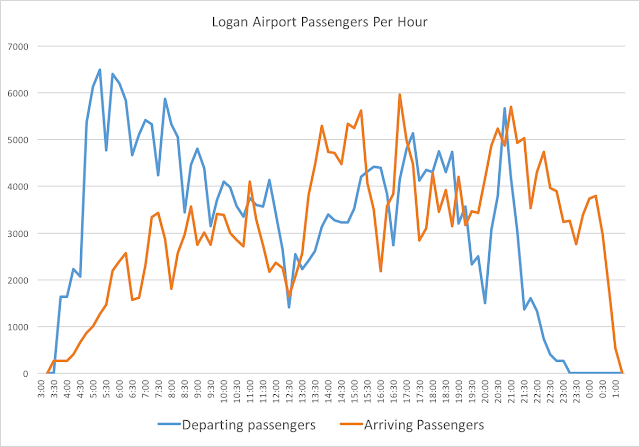

 (Note, the seat numbers for arrivals and departures don't exactly match because each day at Logan is not identical and this was a snapshot of a day. This is total seats available, not total passengers, and is also a rough estimate based on plane sizes at different times of day, but should show general trends well.)
So, it's clear that there is a good deal more demand to get to the airport in the morning, which doesn't even out until around 9 a.m., various points of imbalance during the day, and then, starting around 7 p.m., significantly more demand to leave the airport.
A couple of personal anecdotes can illustrate this. The first illustrates the imabalce in the morning. Back before the Big Dig was completed (and, in fact, pre-Silver Line, and back when the airport had half the traffic it has today), when I was going to college, getting to the airport was, perhaps, worse than today. It involved both the elevated Central Artery and then the Sumner/Callahan tunnel complex: a trip to or from the airport to downtown could take an hour (which is, of course, not much different than it is now). For several years, however, the Ted Williams Tunnel had been open to commercial vehicles only. The connecting highways were not yet complete, so this was a way to keep the local streets from getting overrun by people trying avoid the congestion.
From Newton, where I grew up, my father came up with a solution, especially for early morning departures. He would drive me to South Station. Rather than risk the airport traffic, I'd get in a cab for the usually $10 or $12 trip under the harbor in the tunnel only cabs could use. Early one morning, I got in a cab at South Station and told the driver I was going to the airport. He quoted the fare: "$20" and didn't turn on the meter. What I should have done is say "I'll pay you whatever the meter quotes at the end of the ride, so it's in your best interest to turn it on now," but I was 18 and hadn't quite figured that out, so at the airport, I paid him $20, noted his medallion number, and immediately reported it.
A month later my dad got a check for $20 from the Boston Police (which oversee taxi medallions), along with a note that the taxi driver had been given a stern talking to that he was never to refuse to turn on the meter for a trip within the city.
But I understand why the driver was reticent to take the fare. He would get to the airport and have two (bad) decisions. One would be to go to the taxi pool and wait in line for an fare back to the city: a long line, because there is much less demand going in to the city at 7 a.m. than there are taxis arriving at the airport. The other would be go cross back downtown without a passenger, but still incur the cost of driving, as well as the tunnel toll (which was one-way inbound at that point), with no passenger to pay it. Still, because of redeye arrivals from the West Coast in the morning, there is some traffic for cabs that do make it to the airport going back, although they have to cycle through the cab pool (or the Uber/Lyft pool) before their next fare. Even now, if you take a cab or a ride-hail vehicle to the airport in the morning, the driver is probably not particularly happy taking the fare.
The second example was an extreme example of the late-night issue. I was flying back from SLC and the flight was delayed several hours. Originally scheduled in at 11:30 (plenty of time to catch the Silver Line downtown and take the T home), the plane was more than three hours late, and didn't arrive in Boston until about 2:30. The airport was empty. Yet a 757 had arrived with 200 passengers, and no one was making the trip at that point to pick us up. So we all converged on the cab stand, but there wasn't a cab in sight. Immediately, people started self-pooling: it was clear that if we all took our own cabs, the line wouldn't clear for hours. "Who's going to Brookline?" "I'm going to JP, that's close!" "I'm going to Concord." "I'm going to Lexington, let's share." Every few minutes, a stray cab would roll up, three overtired strangers would pile in, and the line would get slightly shorter. I found a cab pretty quickly, but imagine those at the back of the line may have seen the sun rise.
Finally, here's a picture of the departures level at Terminal A at 8 p.m. this past week.

Delta's last domestic flight leaves at 7:45 (to MCO) and the last hub-based flight leaves at 6:56 (for ATL). Two international flights leave around 8:30. At this time, it's a ghost town. Note: if you're picking someone up at the airport in the evening, plan to meet them on the upper level, and note that Terminal A is a great place to wait without having State Police harass you. (Terminal B was pretty quiet, too.)
Here are scheduled arrivals and departures, by carrier, at different times of day:

 Note: not all regional flights appear to be in this sample, for instance, there are no Cape Air flights shown after mid-evening, when Cape Air flies several late flights out of Boston, but these flights are minimal as far as number of arriving passengers is concerned.
Notice how departures peak in the morning, then lull in the midday, and then have a secondary peak in the evening, before domestic departures (except for JetBlue) tail off quickly after 7 p.m. International carrier flights are clustered arriving in the afternoon and leaving in the evening. But there is a clear imbalance for flights arriving and departing the airport.
In any case, this has been a problem for years, and it's a structural issue pertinent to Logan Airport based on the airport's geography on both a macro and micro scale. On a macro scale, the geography of the airport at the corner of the country means that, late in the evening, flights feed into it but don't feed out. On a micro scale, the airport's geography encourages taxi/app-ride/ride-hail use (I'll call these taxis, for simplicity). The constrained location means that parking costs are high, because demand for parking outstrips supply. The proximity to areas with high trip generation (downtown, and high density areas nearby) means that taxi costs are often significantly lower than a day's parking cost ($38) in the garage. The combination of these factors push many people to use taxis.
Much of the day, taxi supply roughly matches demand, and there is a minimal delay for these services. But this breaks down at the beginning and end of the day, especially in the evening. Once again, Logan's geography comes into play. While the airport is close to the city geographically, it is expensive to get to for a taxi driver. When there is high demand for fares back to the city at 1 a.m.—especially once buses have, for the most part, stopped running—there is negligible demand to get to the airport, or even East Boston in general, so to pick up any fare would require the driver to deadhead to the airport.
Unless a driver happens to pick up a stray fare to East Boston, this requires a driver to travel several miles, and to pay the cost of the tunnel toll. Once at the airport, there is no promise that the trip home will be lucrative enough to cover these costs. They might get a $50 fare to a far-flung suburb. But it might only be a $15 fare to a downtown hotel or, worse, to Revere or Winthrop, meaning a driver would then have to drive back home—likely through the tunnel—and foot the bill for the toll both ways. Moreover, this is the end of the day for most drivers: except on a Friday or Saturday night, there is only so much demand for rides after 1 a.m. For many drivers, the potential upside of getting a decent fare from the airport doesn't make up for the potential downsides, especially when the alternative is shutting off the app (or taximeter), driving home, and going to bed an hour earlier. There is a high disincentive to be in the last group of taxis at the airport: a driver might get one of the last passengers, but if not, there is not likely a job for several hours when the first redeye flights start to trickle in around 4 a.m. There is little incentive for taxicab drivers to go to the airport during this dwindling time, so demand is only met by drivers already in East Boston who need a fare back to the city.
This is not an easy issue to solve. It also shows why Uber and Lyft are basically just taxis: they are subject to the same supply and demand issues that affect the rest of the market. Alas, they're providing the same service: a chauffeured ride from Point A to Point B. And the airport is pretty much the only place that cabs still have a foothold, partially because matching passengers to specific vehicles is quite inefficient with large groups, like you might find at an airport. This has been a recent point of contention at LAX, which consolidated its taxi and ride-hail facilities away from the terminals (as Logan is planning). It hasn't gone particularly well to start, but I would venture to guess that there are similar supply and demand issues at LAX. (As several people have pointed out, the buses there are running much more smoothly, too.)
Of course, at LA, there is a temporal aspect to the complaints about #LAXit. Most of the issues are in the evening. Los Angeles has more balanced operations, with plenty of departures in the evening, both redeyes to the East Coast and transcontinentals, mostly TPACs but some TATLs as well. There is probably both more demand for cabs in the evening because LA is on the opposite side of the country as Boston, and also because most of the transcon redeyes leave before 11 p.m., and most of the later flights are international, which are fed more by connecting travelers and by passengers arriving at the airport much earlier. Thus, for the actual demand for taxis, there is a similar, if less pronounced, demand compared with Boston.
I scraped Twitter for #LAXit from the first few days and it seems clear that the issue is mostly in the evening.

But back to Boston. Here's what the Logan cab pool Twitter feed (because of course Logan's taxis have a Twitter feed) looked like last Sunday. There was a cab shortage by 8 p.m., and the late night arrival issue was foreseen by 10 p.m. It wasn't a surprise. It is a market issue.

Is this feed a bot? Certainly not! Note the wrong months, typos, misspellings, random numbers of hyphens and use of quotations. The one thing that seems constant is the use of the word "need" when the airport has a cab shortage (with various qualifiers like all-caps or exclamation marks). I'm pretty sure it's a guy standing by the taxi pool furiously typing tweets into the Twitter machine. So, I decided to scrape the feed (about 60,000 tweets), and code each tweet by whether it included the word "need" or not, to get a very rough estimate of the frequency of taxi delays at Logan.
From the charts of arrivals and departures above, we would assume that the airport would generally need cabs mid-afternoon, as well as in the evening. If we chart the arrival and departure relationship and the Twitter feed's need for cabs together, and we shift the need for cabs back 1:15 (probably due to actual behavior of arriving passengers), voila, they match pretty darned well.

A few other notes on the need for cabs:

TL;DR: it is definitely getting harder to get a cab at the airport, especially during certain times of the year and at certain times of day. And when flights are delayed, this is exacerbated. Departing passengers generally still get to the airport on time, but arriving passengers get in later, meaning the cab shortage is even more acute. Which leads to situations like the one which occurred earlier this week at the start of this post, which may have taken you nearly that long to read
So what can be done about it? Well, Uber/Lyft could use their surge features to increase the cost of a trip to the point where it would make economic sense for drivers to come to the airport at this time of day. But that might double or triple the cost of a ride, so while it is a very market-based solution to the problem, it is not consumer-friendly. It (and taxi starters) could do a better job of pooling rides, and moving the Ubers and Lyfts to the same site might make pooling easier there. A very low-tech idea might be to figure out where vehicles are going and, at high-demand times, put people into lines based on regions to help them self-pool. This might nibble around the edges on the demand side, but it doesn't help supply. It turns out that Lyft and Uber are not a magic panacea to mobility: they are subject to the same supply and demand issues as the rest of the world. And if the answer is pricing, it's not a great answer, especially since prices might have to go up significantly to provide enough supply or suppress demand enough to satisfy market equilibrium, especially after midnight when there are really no other options available.
One solution, I think, is that rather than trying to bring supply to the demand, we should move the demand to where there is more supply: get people, en masse, downtown. This requires a magical invention: the bus. While the supply of hire cars is not limitless (there are only about 1800 taxicabs in Boston, and probably far fewer are active today, and many more Ubers and Lyfts, but a finite number), it is significantly less constrained on the other side of the Harbor. Instead of trying to entice drivers to come to the airport, we could instead move riders to where are there are more cars. Most riders are going north, west or south of the airport, and need a ride through Downtown Boston anyway. The bus might not be that appealing to a traveler at 1 a.m., but neither is a 45 minute taxi ride. This basically takes what LA is doing, and extends it a couple of miles.
The MBTA runs the Silver Line until 1:15 a.m., which could easily bring passengers to South Station, where catching a taxi or ride hail vehicle is easier than at the airport. Massport and the T, however, do a poor job of advertising these late buses, both with signage telling passengers the hours as well as real-time information about the buses' whereabouts (important especially if you are unsure if the last bus has left). But these are easy issues to solve. The bus real-time data is available: I have no issue pulling it up on mbtainfo.com, for instance.
 Not helpful, especially if you're trying to figure out if the last bus has left, or even deciding if it's worth waiting in a cab line versus waiting for the bus.
And Massport could put up static signage:
BUSES EVERY 8-15 MIN UNTIL 1:15 AM
And as I've written before, with some minor schedule tweaks, the T could use the Silver Line 3 returns from Chelsea to supplement this service even later, and keep one bus in service to make an extra round trip to provide service until 2:30 when, on most nights, the planes have all landed. Alternatively, or in addition, Massport could continue its Back Bay Logan Express bus later in the evening and into the early morning (or even 24/7), providing late night trips to the taxicab-rich parts of Boston when there are cab shortages at the airport (and perhaps even direct service to large hotels in the Back Bay).
Even more, the Logan Taxi Twitter feed often includes this kind of Tweet:
The market has never provided enough cabs at Logan when they are needed, and at certain times of day, lines of cabs are the rule, not the exception. Assuming the market will take care of this has never worked, and it is unlikely that it ever will. If Massport worked with the MBTA, however, it could pilot a project to move people downtown and create a secondary taxi queue there, where drivers would be much more willing to go for a fare, because even if the demand had dried up, they wouldn't be out the tunnel tolls, mileage and time to show up at the airport.
Then she went to check out the Uber/Lyft line and it was no better:The line for taxis at Logan (not TNCs) has 100+ people after midnight. The TNC pickup equally chaotic & crowded. Insane. pic.twitter.com/IjYPI1X1OR— Jan Devereux (@jandev) October 28, 2019
By 1:30, others reported that the cab line was an hour long.Meanwhile it’s a zoo in the TNC line at Logan @Massport @MassGovernor 12:46am Sun night pic.twitter.com/W2z4IOW29f— Jan Devereux (@jandev) October 28, 2019
What's going on here? Where are all the taxis? Where are all the Ubers? Why are people arriving at the airport after midnight then waiting an hour for a ride home? What can we do about this?Things got even worse after 1:30am. Made it 3/4ths of the way down the cab line in 45 minutes before sharing a ride.— Ryan Cullen (@transporyan) October 28, 2019
Late night SL service noted for next time! pic.twitter.com/Od4MuY3dvG
It's not really a simple answer. Please, though, follow me down a rabbit hole.
Logan airport is not a hub airport (okay, not really: Delta and especially JetBlue are doing their best to create a hub, but it still is mostly an origin-destination airport). This is a matter of geography: because it is tucked away at the northeast corner of the country, the airport mostly handles passengers flying in one direction, south or west, either on direct flights, or to other domestic hubs (although international travel has increased markedly in recent years, and JetBlue even has a bank of later domestic flights to accommodate connecting passengers).
Boston's flights can be grouped in to three main types: short haul flights to non-hub cities, short-haul flights to hub cities, and long hauls, both domestic and international. Only the first group operates without geographic constraints which dictate that flights can only arrive and depart at certain times of day. Non-hub short-haul flights, mostly on JetBlue and Delta (to places like AUS, BUF, RDU, MKE) are spread more evenly throughout the day, because they don't have to make connections at hubs. Hub-based flights within the eastern half of the United States (say, as far as MIA, DFW and MSP). These flights account for many of the early departures, but few leave Boston after early evening. They don't arrive in Boston until mid-morning, but are the bulk of the last flights arriving later in the evening. Because of these travel patterns, Logan has a lot of early and late flights: in the morning, people want to get to a connecting hub for the first "bank" of connecting flights, and in the evening, flights have to leave the connecting hub after the last bank has occurred.
(Not all airlines utilize banking at hubs—Southwest most notably runs continuous hubs—and there are pluses and minuses to each method, about which I won't go into too much depth here. But basically, banking decreases fleet utilization and increases congestion at hub airports since flights arrive and depart all at the same time, followed, in some cases, by periods of relatively low flight activity, but passengers have much shorter connection times at hubs since connections are coordinated. It's actually something like a pulse system for buses, except that airports have finite numbers of vehicles which can arrive and depart at any given time, and longer dwell times. As airlines have consolidated, hubs have grown and seen more frequent banks such that they are now closer to continuous operation, especially at large airports like Atlanta and Chicago. See how this is a rabbit hole? Also, when I say people want to connect to the first bank, I mostly mean airlines, no rational human being wants to be on a flight departing at 5:15 a.m.)
Then there are longer-haul flights. Transcons have to deal with time changes, cycle times, and the fact that flights generally don't depart or arrive between 1 a.m. and 5 a.m. local time. So they arrive from the West Coast either as redeyes between 5 and 10 a.m., and then turn to depart between 6 and noon, or as day flights, arriving in the afternoon or evening. Thus, in addition to the overnight lull, there are basically no transcons which arrive in or depart Boston during the midday. International flights (mostly TATLs) generally are redeye flights going out, leaving Boston in the evening, and return during the middle of the day, arriving in the afternoon. All told, Boston has demand throughout the day, but particularly high demand for flights arriving later in the evening.
For instance, O'Hare and Atlanta, the two busiest airports in the country (by number of aircraft movements), have 29 and 24 flights scheduled to arrive after 11 p.m., respectively. Boston has 39. After 11 p.m., Boston is basically the busiest passenger airport in the country (about tied with LAX), and possibly the world (since in many countries, airports have noise regulations which limit late night flights). Yet at the same time, there are few flights departing Boston. The airport has only 14 scheduled departures after 11 p.m., and only six of these are domestic flights (all are JetBlue E190s, so they're small planes). There is basically zero demand for passengers to get to the airport late at night. This creates a demand imbalance for ground transportation: there's a lot of demand to leave the airport at midnight, but almost no one who wants to go there.
Here are some charts of the approximate number of airline seats arriving and leaving Boston. I adjusted for the typical arrival time at the airport (60 minutes for domestic, 120 for international) and assumed it would take 30 minutes for the average international passenger to clear customs.


So, it's clear that there is a good deal more demand to get to the airport in the morning, which doesn't even out until around 9 a.m., various points of imbalance during the day, and then, starting around 7 p.m., significantly more demand to leave the airport.
A couple of personal anecdotes can illustrate this. The first illustrates the imabalce in the morning. Back before the Big Dig was completed (and, in fact, pre-Silver Line, and back when the airport had half the traffic it has today), when I was going to college, getting to the airport was, perhaps, worse than today. It involved both the elevated Central Artery and then the Sumner/Callahan tunnel complex: a trip to or from the airport to downtown could take an hour (which is, of course, not much different than it is now). For several years, however, the Ted Williams Tunnel had been open to commercial vehicles only. The connecting highways were not yet complete, so this was a way to keep the local streets from getting overrun by people trying avoid the congestion.
From Newton, where I grew up, my father came up with a solution, especially for early morning departures. He would drive me to South Station. Rather than risk the airport traffic, I'd get in a cab for the usually $10 or $12 trip under the harbor in the tunnel only cabs could use. Early one morning, I got in a cab at South Station and told the driver I was going to the airport. He quoted the fare: "$20" and didn't turn on the meter. What I should have done is say "I'll pay you whatever the meter quotes at the end of the ride, so it's in your best interest to turn it on now," but I was 18 and hadn't quite figured that out, so at the airport, I paid him $20, noted his medallion number, and immediately reported it.
A month later my dad got a check for $20 from the Boston Police (which oversee taxi medallions), along with a note that the taxi driver had been given a stern talking to that he was never to refuse to turn on the meter for a trip within the city.
But I understand why the driver was reticent to take the fare. He would get to the airport and have two (bad) decisions. One would be to go to the taxi pool and wait in line for an fare back to the city: a long line, because there is much less demand going in to the city at 7 a.m. than there are taxis arriving at the airport. The other would be go cross back downtown without a passenger, but still incur the cost of driving, as well as the tunnel toll (which was one-way inbound at that point), with no passenger to pay it. Still, because of redeye arrivals from the West Coast in the morning, there is some traffic for cabs that do make it to the airport going back, although they have to cycle through the cab pool (or the Uber/Lyft pool) before their next fare. Even now, if you take a cab or a ride-hail vehicle to the airport in the morning, the driver is probably not particularly happy taking the fare.
The second example was an extreme example of the late-night issue. I was flying back from SLC and the flight was delayed several hours. Originally scheduled in at 11:30 (plenty of time to catch the Silver Line downtown and take the T home), the plane was more than three hours late, and didn't arrive in Boston until about 2:30. The airport was empty. Yet a 757 had arrived with 200 passengers, and no one was making the trip at that point to pick us up. So we all converged on the cab stand, but there wasn't a cab in sight. Immediately, people started self-pooling: it was clear that if we all took our own cabs, the line wouldn't clear for hours. "Who's going to Brookline?" "I'm going to JP, that's close!" "I'm going to Concord." "I'm going to Lexington, let's share." Every few minutes, a stray cab would roll up, three overtired strangers would pile in, and the line would get slightly shorter. I found a cab pretty quickly, but imagine those at the back of the line may have seen the sun rise.
Finally, here's a picture of the departures level at Terminal A at 8 p.m. this past week.

Delta's last domestic flight leaves at 7:45 (to MCO) and the last hub-based flight leaves at 6:56 (for ATL). Two international flights leave around 8:30. At this time, it's a ghost town. Note: if you're picking someone up at the airport in the evening, plan to meet them on the upper level, and note that Terminal A is a great place to wait without having State Police harass you. (Terminal B was pretty quiet, too.)
Here are scheduled arrivals and departures, by carrier, at different times of day:


Notice how departures peak in the morning, then lull in the midday, and then have a secondary peak in the evening, before domestic departures (except for JetBlue) tail off quickly after 7 p.m. International carrier flights are clustered arriving in the afternoon and leaving in the evening. But there is a clear imbalance for flights arriving and departing the airport.
In any case, this has been a problem for years, and it's a structural issue pertinent to Logan Airport based on the airport's geography on both a macro and micro scale. On a macro scale, the geography of the airport at the corner of the country means that, late in the evening, flights feed into it but don't feed out. On a micro scale, the airport's geography encourages taxi/app-ride/ride-hail use (I'll call these taxis, for simplicity). The constrained location means that parking costs are high, because demand for parking outstrips supply. The proximity to areas with high trip generation (downtown, and high density areas nearby) means that taxi costs are often significantly lower than a day's parking cost ($38) in the garage. The combination of these factors push many people to use taxis.
Much of the day, taxi supply roughly matches demand, and there is a minimal delay for these services. But this breaks down at the beginning and end of the day, especially in the evening. Once again, Logan's geography comes into play. While the airport is close to the city geographically, it is expensive to get to for a taxi driver. When there is high demand for fares back to the city at 1 a.m.—especially once buses have, for the most part, stopped running—there is negligible demand to get to the airport, or even East Boston in general, so to pick up any fare would require the driver to deadhead to the airport.
Unless a driver happens to pick up a stray fare to East Boston, this requires a driver to travel several miles, and to pay the cost of the tunnel toll. Once at the airport, there is no promise that the trip home will be lucrative enough to cover these costs. They might get a $50 fare to a far-flung suburb. But it might only be a $15 fare to a downtown hotel or, worse, to Revere or Winthrop, meaning a driver would then have to drive back home—likely through the tunnel—and foot the bill for the toll both ways. Moreover, this is the end of the day for most drivers: except on a Friday or Saturday night, there is only so much demand for rides after 1 a.m. For many drivers, the potential upside of getting a decent fare from the airport doesn't make up for the potential downsides, especially when the alternative is shutting off the app (or taximeter), driving home, and going to bed an hour earlier. There is a high disincentive to be in the last group of taxis at the airport: a driver might get one of the last passengers, but if not, there is not likely a job for several hours when the first redeye flights start to trickle in around 4 a.m. There is little incentive for taxicab drivers to go to the airport during this dwindling time, so demand is only met by drivers already in East Boston who need a fare back to the city.
This is not an easy issue to solve. It also shows why Uber and Lyft are basically just taxis: they are subject to the same supply and demand issues that affect the rest of the market. Alas, they're providing the same service: a chauffeured ride from Point A to Point B. And the airport is pretty much the only place that cabs still have a foothold, partially because matching passengers to specific vehicles is quite inefficient with large groups, like you might find at an airport. This has been a recent point of contention at LAX, which consolidated its taxi and ride-hail facilities away from the terminals (as Logan is planning). It hasn't gone particularly well to start, but I would venture to guess that there are similar supply and demand issues at LAX. (As several people have pointed out, the buses there are running much more smoothly, too.)
Of course, at LA, there is a temporal aspect to the complaints about #LAXit. Most of the issues are in the evening. Los Angeles has more balanced operations, with plenty of departures in the evening, both redeyes to the East Coast and transcontinentals, mostly TPACs but some TATLs as well. There is probably both more demand for cabs in the evening because LA is on the opposite side of the country as Boston, and also because most of the transcon redeyes leave before 11 p.m., and most of the later flights are international, which are fed more by connecting travelers and by passengers arriving at the airport much earlier. Thus, for the actual demand for taxis, there is a similar, if less pronounced, demand compared with Boston.
I scraped Twitter for #LAXit from the first few days and it seems clear that the issue is mostly in the evening.

But back to Boston. Here's what the Logan cab pool Twitter feed (because of course Logan's taxis have a Twitter feed) looked like last Sunday. There was a cab shortage by 8 p.m., and the late night arrival issue was foreseen by 10 p.m. It wasn't a surprise. It is a market issue.

From the charts of arrivals and departures above, we would assume that the airport would generally need cabs mid-afternoon, as well as in the evening. If we chart the arrival and departure relationship and the Twitter feed's need for cabs together, and we shift the need for cabs back 1:15 (probably due to actual behavior of arriving passengers), voila, they match pretty darned well.

A few other notes on the need for cabs:
- There is more demand on Sundays (36% of Tweets include the word "need"), followed by Mondays, Thursdays and Fridays (28%), with the least demand on Saturdays (20%)
- The cab shortage is generally higher in the summer than the winter (and highest in May, June, September and October, while lowest in December, January and February), and it has been particularly high this year. In fact, the only higher demand for cabs at the airport was in February of 2015. I wonder why.

TL;DR: it is definitely getting harder to get a cab at the airport, especially during certain times of the year and at certain times of day. And when flights are delayed, this is exacerbated. Departing passengers generally still get to the airport on time, but arriving passengers get in later, meaning the cab shortage is even more acute. Which leads to situations like the one which occurred earlier this week at the start of this post, which may have taken you nearly that long to read
So what can be done about it? Well, Uber/Lyft could use their surge features to increase the cost of a trip to the point where it would make economic sense for drivers to come to the airport at this time of day. But that might double or triple the cost of a ride, so while it is a very market-based solution to the problem, it is not consumer-friendly. It (and taxi starters) could do a better job of pooling rides, and moving the Ubers and Lyfts to the same site might make pooling easier there. A very low-tech idea might be to figure out where vehicles are going and, at high-demand times, put people into lines based on regions to help them self-pool. This might nibble around the edges on the demand side, but it doesn't help supply. It turns out that Lyft and Uber are not a magic panacea to mobility: they are subject to the same supply and demand issues as the rest of the world. And if the answer is pricing, it's not a great answer, especially since prices might have to go up significantly to provide enough supply or suppress demand enough to satisfy market equilibrium, especially after midnight when there are really no other options available.
One solution, I think, is that rather than trying to bring supply to the demand, we should move the demand to where there is more supply: get people, en masse, downtown. This requires a magical invention: the bus. While the supply of hire cars is not limitless (there are only about 1800 taxicabs in Boston, and probably far fewer are active today, and many more Ubers and Lyfts, but a finite number), it is significantly less constrained on the other side of the Harbor. Instead of trying to entice drivers to come to the airport, we could instead move riders to where are there are more cars. Most riders are going north, west or south of the airport, and need a ride through Downtown Boston anyway. The bus might not be that appealing to a traveler at 1 a.m., but neither is a 45 minute taxi ride. This basically takes what LA is doing, and extends it a couple of miles.
The MBTA runs the Silver Line until 1:15 a.m., which could easily bring passengers to South Station, where catching a taxi or ride hail vehicle is easier than at the airport. Massport and the T, however, do a poor job of advertising these late buses, both with signage telling passengers the hours as well as real-time information about the buses' whereabouts (important especially if you are unsure if the last bus has left). But these are easy issues to solve. The bus real-time data is available: I have no issue pulling it up on mbtainfo.com, for instance.

And Massport could put up static signage:
NO CABS? NO PROBLEM!
GET A CAB ACROSS THE HARBOR
MBTA BUS TO SOUTH STATION
SKIP THE LINE — SAVE MONEY
BUSES EVERY 8-15 MIN UNTIL 1:15 AM
ADDITIONAL BUS AT 2:30 AM
Even more, the Logan Taxi Twitter feed often includes this kind of Tweet:
By 10:00 most evenings, someone at Logan knows how many late flights are coming in. So, conceivably, the bus driver could be held on duty to make extra trips in the cases of delays. Massport, which already helps to subsidize the fares for the Silver Line, could shoulder the rather minimal cost of the extra trips. And passengers arriving at midnight would no longer have to face an hour-long wait for a cab, when there are many more options across the harbor.10/31/2019— Logan Taxi Pool (@LoganTaxi) November 1, 2019
LAST FLIGHTS 11PM - 12AM (22) 12AM - 1AM (17) 1AM-2AM (7)
LAST FLIGHT 3:29 am. *SUBJECT TO CHANGE*
The market has never provided enough cabs at Logan when they are needed, and at certain times of day, lines of cabs are the rule, not the exception. Assuming the market will take care of this has never worked, and it is unlikely that it ever will. If Massport worked with the MBTA, however, it could pilot a project to move people downtown and create a secondary taxi queue there, where drivers would be much more willing to go for a fare, because even if the demand had dried up, they wouldn't be out the tunnel tolls, mileage and time to show up at the airport.
Thursday, October 17, 2019
The next 10 miles of tunnel in Boston
In the past 30 years, Boston has been a leader (at least in the US) in building tunnels. The Big Dig, which removed the eyesore Central Artery from the center of the city and doubled highway capacity to the East Boston and the airport (which likely has something to do with the making Logan Airport one of the fastest-growing in the country), was one of the largest subterranean endeavors in the country's history. (If you really want to see tunnels, though, head to Europe or Japan. But I digress.)
In that time, however, the region has not built any new high-capacity, subterranean transit infrastructure aside from relocating the Green Line at North Station, which didn't add any connectivity or capacity (and it was part of the Big Dig, anyway). The Silver Line is not high capacity by any stretch of the imagination (although if it were converted to light rail, it could be much higher). Even the Green Line Extension, the first new line in decades, is being built entirely at- or above-grade.
Our competitor cities, even those in the US, are not standing still. While American cities are notoriously poor at building subways with any sort of cost controls, most every other city in the country with any sort of transit system has built some amount of underground rail infrastructure. Why do I focus on going underground? Because it's the only way to run high-capacity transportation through a dense portion of a city. Without it, we are stuck trying to push more and more people through the infrastructure we already have: our overcrowded subways and narrow streets. We can do this, to a point. But at some juncture, we need to think bigger.
Here are what other cities have been doing since the last new subway station opened in Boston (either in 1985, when Alewife opened, or 1987, when the Southwest Corridor replaced the elevated Orange Line), from west to east (approximately, and if I missed anyone, let me know):
So, why Boston? Why now? Because there are several short stretches which could dramatically enhance the network, and the overall capacity of the network needs to be expanded. The last increase to the system's capacity was made in the early 1900s: since then, lines have been relocated, but not expanded. This doesn't go into the need for wider-scale regional connectivity or faster, more efficient surface transit (both are important, but cover a much broader scale). It instead focuses on how a few miles of tunnels could transform transit capacity in the city. Much like, for better or for worse, the Big Dig did. It's a very blue-sky approach and assumes a reasonably large investment (the state does have a billion dollar surplus), but each project is technically feasible and in most cases encompass projects which have been proposed at some point in the city's history (albeit in some cases, a long time ago).
They are presented in approximate order of length (shortest to longest) and feasibility.
1. The Red-Blue connector (0.25 miles)
The Red-Blue connector would require about 1300 feet of new tunnel. It's a good time for it: Cambridge Street above it is badly in need of a redesign, and MGH, next door, is planning adjacent construction. The MBTA is finally going to give it a fair shake, and it will hopefully see the light of day in the next few years.
But why is it important? Because it improves connectivity while at the same time reducing demand on the busiest part of the core of the system. It's a win-win, for a very small investment, and should be feasible to build with minimal disruption to the rest of the system.
2. The Silver Line Phase III, but with rails (0.5 miles)
This connection has flown more under the radar screen. With the growth of the Seaport, the Silver Line buses are overburdened, and there is no good way to get to it from the Orange or Green lines without multiple transfers. The Silver Line and Central Artery were designed to include the Silver Line Phase III portion of the project, which would have run east from South Station to Boylston, and then made an asinine loop to run south to a portal somewhere near Tufts Medical Center station (they couldn't use the old Green Line tunnel because, paradoxically, smaller buses require larger tunnels: louder now for those in the back or at Park Plaza, because buses don't belong in tunnels). And it would have run buses, which, as we see today, have no place in tunnels with stops and have low speed and low capacity.
This idea leverages a third piece of infrastructure, and one much older: the never-used provisions for a branch of what is now the Green Line from east of Arlington to a terminal at Post Office Square. Instead of going to Post Office Square, this would extend east along the SL III plans to South Station, then through the Piers Transitway (a.k.a, the current Silver Line, which was designed to be converted to light rail, providing faster and higher-capacity service) and on to Silver Line Way, where it could be extended at-grade to the Convention Center, Seaport or elsewhere, maybe even down Track 61. No, Track 61 as a DMU shuttle just doesn't work. This would mean a one-seat ride from Copley to the Seaport in 8 minutes, as opposed to two transfers and 20 minutes today.
I'll defer to Vanshnookenragen for some detailed graphics about how this would work, and some other good thoughts on the Green Line.
Two tunnels down and we haven't even dug a full mile.
3. Grand Junction (1.25 miles)
Now we get a bit bigger.
The Grand Junction Railroad has never carried a revenue passenger in its existence, which goes back to 1846. Until recently, the right-of-way once ran through a series of industrial lots and rail yards with little potential to carry paying customers. Now? It runs from North Station and passes Cambridge Crossing, runs through the heart of Kendall Square, and then on to Allston. Kendall has some of the highest-priced real estate on the face of the earth, and is growing by leaps and bounds, despite no direct highway access, which forces car traffic onto narrow, congested streets. It's accessible from the Red Line, and has reasonable connections to some of the rest of the transportation system, but from the north and west, transit is not time-competitive with driving, so, people drive.
Cambridge Crossing promises more demand, as does the eventual replacement of the interchange and rail yard in Allston. This provides opportunity as well: for the construction in Allston to take place, the Grand Junction will be shut down for a period of several years. In 10 years, the Grand Junction could connect Allston (millions of square feet of new development adjacent to Harvard and BU's campuses, as well as a transfer from the main east-west rail corridor in the state) to Kendall Square to North Station, with additional stops in Cambridgeport, East Cambridge and Cambridge Crossing (where the line passes only about 600 feet from the future Lechmere Station, which would provide a transit connection from the Green Line extension to Kendall Square).
This looks a lot like where you would want a frequent, high-capacity transit line, which would increase regional transit ridership (satisfying latent demand by providing connections which do not exist today) and take existing transfers out of the core of the system. What do I mean by this? Take the example of Boston Landing station. Before that station opened, there were no good options to use transit from Allston to Downtown Boston: The 86 or 66 bus to Harvard and the Red Line, the 64 bus to Central and then the Red Line, or the 57 bus to Kenmore and then the Green Line. Since it's opened, ridership has far exceeded expectations. Why? Because there's now an option to go from Allston to South Station in 14 minutes instead of 40. Some of this traffic comes from people who used to cram onto the 57 or 64 buses, and others take transit instead of driving.
The Grand Junction allows a similar time savings for travel to Kendall Square, except expands the benefit to everyone coming west of Boston. A trip from Boston Landing to Kendall today involves a 35 minute ride on the 64 bus, or taking a train to South Station and then the Red Line out; without the Grand Junction, traveling between West Station and Kendall will have a similar travel time, all for a trip which will cover, as the crow flies, little more than a mile. The Grand Junction is a straight line between the Worcester Line and Kendall Square, and cuts 20 minutes from the transit commute for every current or prospective passenger going to Kendall from west of Boston. The issue is that the Grand Junction runs across four heavily-trafficked city streets in Cambridge, and providing safe passage for even moderate operating speeds or frequency would be exceedingly difficult. Unless, of course, the line were put underground.
There are two main obstacles to tunneling the Grand Junction, but one major opportunity. The first obstacle is that it can't be a simple, shallow cut-and-cover trench, because in addition to utilities (which are present in most subway projects) the line would have to cross under the Red Line at Main Street. This would mean tunneling down below the grade of the Red Line, with the bottom of the tunnel likely reaching down 40 or 50 feet. Insurmountable? Given how many buildings in Kendall Square have recently been built with footings and basements at least that deep, no. Difficult? Yes.
The second obstacle is the land ownership. While the state has an easement across the corridor in perpetuity, it does not actually own much of it. When the Penn Central was looking to raise cash in the late 1960s and early 1970s, it sold off portions of its railroad to whoever would buy. In the case of much of the Grand Junction, the buyer was MIT. The wide corridor allows MIT to manage deliveries to its buildings and utilities under the surface, with a transportation easement on the surface for the rail line. While MIT has acquiesced to move the Grand Junction Path forward, digging a deep tunnel would be more difficult.
The opportunity, however, is that because of the Allston project, the corridor will see no rail service for a period of several years. Unlike something like the Green Line extension, where much of the cost of the project stems from rebuilding the corridor while maintaining active Commuter Rail service, the Grand Junction corridor would be a blank slate. It's much easier to dig a hole when you don't have to worry about what is going on above it. Roads could be shifted (shoo-flied) to allow for construction to take place (like how Harvard shifted Western Avenue in Allston for construction of an adjacent building). Work wouldn't have to be relegated to evenings and weekends to maintain weekday train service. Given the depth of the Red Line, MIT's utilities between Main Street and Mass Ave could be put into a newly-built conduit above the Grand Junction, allowing far easier access than the current procedure of digging around an active rail line and holes in the middle of Mass Ave. Cut-and-cover projects can be very expensive under city streets or other active alignments. But digging what amounts to little more than a mile-long basement shouldn't be impossible.
The Main Street is more difficult, but a concept would require closing Main Street (or shifting it), uncapping the Red Line, and digging down on both sides of the tracks while maintaining service. Once the pits on both sides were at the eventual depth of the Grand Junction passing underneath, the Red Line could be shut down for a week (perhaps the very low-ridership Christmas-to-New Years week) and a prefabricated concrete box could be assembled off-site and lowered into place, with service restored on the upper portion for the Red Line and, eventually, for the Grand Junction below. MassDOT is good at installing bridges in a weekend. This is essentially the same thing: the bridge takes the Red Line over the Grand Junction.
A few more concepts:


In that time, however, the region has not built any new high-capacity, subterranean transit infrastructure aside from relocating the Green Line at North Station, which didn't add any connectivity or capacity (and it was part of the Big Dig, anyway). The Silver Line is not high capacity by any stretch of the imagination (although if it were converted to light rail, it could be much higher). Even the Green Line Extension, the first new line in decades, is being built entirely at- or above-grade.
Our competitor cities, even those in the US, are not standing still. While American cities are notoriously poor at building subways with any sort of cost controls, most every other city in the country with any sort of transit system has built some amount of underground rail infrastructure. Why do I focus on going underground? Because it's the only way to run high-capacity transportation through a dense portion of a city. Without it, we are stuck trying to push more and more people through the infrastructure we already have: our overcrowded subways and narrow streets. We can do this, to a point. But at some juncture, we need to think bigger.
Here are what other cities have been doing since the last new subway station opened in Boston (either in 1985, when Alewife opened, or 1987, when the Southwest Corridor replaced the elevated Orange Line), from west to east (approximately, and if I missed anyone, let me know):
- Los Angeles: The entire Metro Rail system has opened, with 18.5 miles of tunnels. With in the next decade, the amount of tunnel will nearly double as the system expands dramatically.
- San Francisco: The BART system was mostly complete by the 1980s, including the tunnels. Since then several miles of tunnel opened in South City and San Bruno with the Millbrae/SFO extension, and several more are planned as the line is built (expensively) through San Jose. Muni is building a new tunnel diagonally across San Francisco for light rail service. At some point, Caltrain, which is currently being electrified, may be extended to the Transbay Terminal.
- Portland: While the MAX light rail system is mostly at- or above-grade, the three-mile Robertson Tunnel runs through a major ridge west of downtown.
- Seattle originally opened its mile-long bus tunnel in 1989. It has since converted it for light rail traffic, extended the light rail south (with a mile of tunnel through Beacon Hill), north (in a deep bore tunnel) and will continue with northward expansion as part of a major infrastructure plan which involves building more than 100 miles of high-capacity light rail by 2041.
- The middle of the country has not seen much in the way of tunneling. Denver's system is entirely at-grade, while Dallas has one subway station. Saint Louis has about a mile of tunnel under downtown and shorter tunnels elsewhere. Minneapolis built a mile-long tunnel under its airport. Pittsburgh built a mile-long tunnel under the Allegheny River, and Chicago built about a mile of tunnel connecting the State Subway to the Dan Ryan Branch, allowing routes to be better optimized. Buffalo's light rail, which runs below grade outside the city, was completed in 1986 but hasn't been extended since.
- While much of the DC Metro system was completed by the mid-1980s, the last bits of tunneling weren't completed until 1999. Baltimore's subway was extended by a mile and a half in 1995.
- New York hasn't built much since 1940, but has still managed the Second Avenue Subway, the F Train under Roosevelt Island and East Side Access (the same tunnel for part of the route), the 7 Train extension and the E train to Jamaica.
- Which leaves Atlanta and Philadelphia. In Atlanta, MARTA's tunnels were completed in the late 1970s and early 1980s. Philly finished connecting its regional rail system in 1982. Much like Boston, these cities haven't made large investments in transit since (although MARTA has been extended as planned, mostly above-grade).
So, why Boston? Why now? Because there are several short stretches which could dramatically enhance the network, and the overall capacity of the network needs to be expanded. The last increase to the system's capacity was made in the early 1900s: since then, lines have been relocated, but not expanded. This doesn't go into the need for wider-scale regional connectivity or faster, more efficient surface transit (both are important, but cover a much broader scale). It instead focuses on how a few miles of tunnels could transform transit capacity in the city. Much like, for better or for worse, the Big Dig did. It's a very blue-sky approach and assumes a reasonably large investment (the state does have a billion dollar surplus), but each project is technically feasible and in most cases encompass projects which have been proposed at some point in the city's history (albeit in some cases, a long time ago).
They are presented in approximate order of length (shortest to longest) and feasibility.
1. The Red-Blue connector (0.25 miles)
The Red-Blue connector would require about 1300 feet of new tunnel. It's a good time for it: Cambridge Street above it is badly in need of a redesign, and MGH, next door, is planning adjacent construction. The MBTA is finally going to give it a fair shake, and it will hopefully see the light of day in the next few years.
But why is it important? Because it improves connectivity while at the same time reducing demand on the busiest part of the core of the system. It's a win-win, for a very small investment, and should be feasible to build with minimal disruption to the rest of the system.
2. The Silver Line Phase III, but with rails (0.5 miles)
This connection has flown more under the radar screen. With the growth of the Seaport, the Silver Line buses are overburdened, and there is no good way to get to it from the Orange or Green lines without multiple transfers. The Silver Line and Central Artery were designed to include the Silver Line Phase III portion of the project, which would have run east from South Station to Boylston, and then made an asinine loop to run south to a portal somewhere near Tufts Medical Center station (they couldn't use the old Green Line tunnel because, paradoxically, smaller buses require larger tunnels: louder now for those in the back or at Park Plaza, because buses don't belong in tunnels). And it would have run buses, which, as we see today, have no place in tunnels with stops and have low speed and low capacity.
This idea leverages a third piece of infrastructure, and one much older: the never-used provisions for a branch of what is now the Green Line from east of Arlington to a terminal at Post Office Square. Instead of going to Post Office Square, this would extend east along the SL III plans to South Station, then through the Piers Transitway (a.k.a, the current Silver Line, which was designed to be converted to light rail, providing faster and higher-capacity service) and on to Silver Line Way, where it could be extended at-grade to the Convention Center, Seaport or elsewhere, maybe even down Track 61. No, Track 61 as a DMU shuttle just doesn't work. This would mean a one-seat ride from Copley to the Seaport in 8 minutes, as opposed to two transfers and 20 minutes today.
I'll defer to Vanshnookenragen for some detailed graphics about how this would work, and some other good thoughts on the Green Line.
Two tunnels down and we haven't even dug a full mile.
3. Grand Junction (1.25 miles)
Now we get a bit bigger.
The Grand Junction Railroad has never carried a revenue passenger in its existence, which goes back to 1846. Until recently, the right-of-way once ran through a series of industrial lots and rail yards with little potential to carry paying customers. Now? It runs from North Station and passes Cambridge Crossing, runs through the heart of Kendall Square, and then on to Allston. Kendall has some of the highest-priced real estate on the face of the earth, and is growing by leaps and bounds, despite no direct highway access, which forces car traffic onto narrow, congested streets. It's accessible from the Red Line, and has reasonable connections to some of the rest of the transportation system, but from the north and west, transit is not time-competitive with driving, so, people drive.
Cambridge Crossing promises more demand, as does the eventual replacement of the interchange and rail yard in Allston. This provides opportunity as well: for the construction in Allston to take place, the Grand Junction will be shut down for a period of several years. In 10 years, the Grand Junction could connect Allston (millions of square feet of new development adjacent to Harvard and BU's campuses, as well as a transfer from the main east-west rail corridor in the state) to Kendall Square to North Station, with additional stops in Cambridgeport, East Cambridge and Cambridge Crossing (where the line passes only about 600 feet from the future Lechmere Station, which would provide a transit connection from the Green Line extension to Kendall Square).
This looks a lot like where you would want a frequent, high-capacity transit line, which would increase regional transit ridership (satisfying latent demand by providing connections which do not exist today) and take existing transfers out of the core of the system. What do I mean by this? Take the example of Boston Landing station. Before that station opened, there were no good options to use transit from Allston to Downtown Boston: The 86 or 66 bus to Harvard and the Red Line, the 64 bus to Central and then the Red Line, or the 57 bus to Kenmore and then the Green Line. Since it's opened, ridership has far exceeded expectations. Why? Because there's now an option to go from Allston to South Station in 14 minutes instead of 40. Some of this traffic comes from people who used to cram onto the 57 or 64 buses, and others take transit instead of driving.
The Grand Junction allows a similar time savings for travel to Kendall Square, except expands the benefit to everyone coming west of Boston. A trip from Boston Landing to Kendall today involves a 35 minute ride on the 64 bus, or taking a train to South Station and then the Red Line out; without the Grand Junction, traveling between West Station and Kendall will have a similar travel time, all for a trip which will cover, as the crow flies, little more than a mile. The Grand Junction is a straight line between the Worcester Line and Kendall Square, and cuts 20 minutes from the transit commute for every current or prospective passenger going to Kendall from west of Boston. The issue is that the Grand Junction runs across four heavily-trafficked city streets in Cambridge, and providing safe passage for even moderate operating speeds or frequency would be exceedingly difficult. Unless, of course, the line were put underground.
There are two main obstacles to tunneling the Grand Junction, but one major opportunity. The first obstacle is that it can't be a simple, shallow cut-and-cover trench, because in addition to utilities (which are present in most subway projects) the line would have to cross under the Red Line at Main Street. This would mean tunneling down below the grade of the Red Line, with the bottom of the tunnel likely reaching down 40 or 50 feet. Insurmountable? Given how many buildings in Kendall Square have recently been built with footings and basements at least that deep, no. Difficult? Yes.
The second obstacle is the land ownership. While the state has an easement across the corridor in perpetuity, it does not actually own much of it. When the Penn Central was looking to raise cash in the late 1960s and early 1970s, it sold off portions of its railroad to whoever would buy. In the case of much of the Grand Junction, the buyer was MIT. The wide corridor allows MIT to manage deliveries to its buildings and utilities under the surface, with a transportation easement on the surface for the rail line. While MIT has acquiesced to move the Grand Junction Path forward, digging a deep tunnel would be more difficult.
The opportunity, however, is that because of the Allston project, the corridor will see no rail service for a period of several years. Unlike something like the Green Line extension, where much of the cost of the project stems from rebuilding the corridor while maintaining active Commuter Rail service, the Grand Junction corridor would be a blank slate. It's much easier to dig a hole when you don't have to worry about what is going on above it. Roads could be shifted (shoo-flied) to allow for construction to take place (like how Harvard shifted Western Avenue in Allston for construction of an adjacent building). Work wouldn't have to be relegated to evenings and weekends to maintain weekday train service. Given the depth of the Red Line, MIT's utilities between Main Street and Mass Ave could be put into a newly-built conduit above the Grand Junction, allowing far easier access than the current procedure of digging around an active rail line and holes in the middle of Mass Ave. Cut-and-cover projects can be very expensive under city streets or other active alignments. But digging what amounts to little more than a mile-long basement shouldn't be impossible.
The Main Street is more difficult, but a concept would require closing Main Street (or shifting it), uncapping the Red Line, and digging down on both sides of the tracks while maintaining service. Once the pits on both sides were at the eventual depth of the Grand Junction passing underneath, the Red Line could be shut down for a week (perhaps the very low-ridership Christmas-to-New Years week) and a prefabricated concrete box could be assembled off-site and lowered into place, with service restored on the upper portion for the Red Line and, eventually, for the Grand Junction below. MassDOT is good at installing bridges in a weekend. This is essentially the same thing: the bridge takes the Red Line over the Grand Junction.
A few more concepts:

- A Grand Junction station could be built between Main Street and Mass Ave, likely where MIT currently has a small, outdated building (Building 44) and an outdated parking garage (N4). North of this is a long-disused MIT property. Combined, these properties create an almost-perfect arrow shape, and comprise nearly 5 acres of developable land. A location atop a transit station could help the City leverage financial support for transit infrastructure in exchange for additional development rights.
- On the north edge of the arrow property, an infill Red Line station could be built at Technology Square, filling a mile-long gap between the Red Line stations at Kendall and Central. This would provide better walking access not only to Tech Square, but also to other nearby developments, including NIBR, University Park and nearby residential districts, as well as a good transfer through the arrow property between the Grand Junction and Red Line. Given the rate of development in the corridor, a new transit station would help to relieve some of the crowding at the two existing stations.
- Construction of a tunnel would allow a widening of the curve radius the Grand Junction currently uses between Main Street and Broadway. This would involve digging up much of the corridor there, but with the railroad already below the Red Line, it would provide the potential to add several hundred below-grade parking spaces below the street and above the rail line, which could be leveraged to allow nearby developers to build new buildings with less parking, or, perhaps, none at all. (In Delft, Netherlands, below-grade parking was integrated into a project burying a rail line.)
- The tunnel would ascend to just below grade at Cambridge Street, and then rise east of there, tying in to the Fitchburg Line near McGrath Highway. This would probably require that Gore/Medford Street was raised several feet to accommodate the railroad grade.
- This obviously would require electrification of at least this portion of the Grand Junction railroad, as well as the completion of additional track accessing North Station, which is planned.
Here is a conceptual section (not to scale!) of a Grand Junction tunnel (looking from Kendall/MIT towards Central/Harvard):

Once the Grand Junction is rebuilt as part of the Allston project, demand for service will likely render this opportunity to shut the line down moot, so it would have to happen within the next decade. Given the opportunity to build a new transit line in an unused corridor, it should.

Once the Grand Junction is rebuilt as part of the Allston project, demand for service will likely render this opportunity to shut the line down moot, so it would have to happen within the next decade. Given the opportunity to build a new transit line in an unused corridor, it should.
That's two miles. Total.
4. Grove Hall-to-Dudley Subway (2 miles)
The first three projects look at core capacity, delivering workers to jobs, and moving people out of transfers in the center of the system. This next one doesn't. If some cars which currently run to Park Street were instead split off to the Seaport, there would be more capacity at Park Street itself. Since the section of subway from Park Street to Boylston is four tracks, and the two extending south through the disused Pleasant Street Incline are grade separated, trains could be run in to the subway from the south, allowing service from Dudley Square to bypass the traffic and narrow streets downtown (because this is what the subway was designed for when it was built in … 1897). In other words, there's plenty of capacity at Park Street, as long as it doesn't all turn west at Boylston.
Why wasn't the subway ever extended south from the Pleasant Portal? Probably because the railroad was in the way and already below grade. To extend the subway would require not just digging a tunnel, but digging it deeper: something that didn't happen for decades anywhere in the system. By and large, other than crossing under each other, Boston's original subways hewed close to the surface.
By 1914, what is now the Green Line subway was extended to just east of Kenmore Square, and only in 1932 did the subway cross under the railroad, first at Beacon Street and then at Huntington Avenue in 1941. (The Turnpike doesn't make this crossing any easier.) The southern branch from Boylston was never extended under the wider New Haven and Boston and Albany right-of-way. But even the few existing, unused blocks of subway between Boylston and the portal would provide a major advantage: allowing service from the Washington Street corridor to bypass downtown traffic and extend north through the city. There is relatively little congestion south of there, and ample opportunity to run transit in a right-of-way on Washington Street: that's where the Silver Line has lanes, even if it doesn't need them. The Pleasant Portal could be reopened, and the line extended diagonally on the original route of the now-obliterated Pleasant Street across the land occupied by the 1970s-era Josiah Quincy School (which will likely need refurbishment or replacement at some point), and then down Washington Street.
By 1914, what is now the Green Line subway was extended to just east of Kenmore Square, and only in 1932 did the subway cross under the railroad, first at Beacon Street and then at Huntington Avenue in 1941. (The Turnpike doesn't make this crossing any easier.) The southern branch from Boylston was never extended under the wider New Haven and Boston and Albany right-of-way. But even the few existing, unused blocks of subway between Boylston and the portal would provide a major advantage: allowing service from the Washington Street corridor to bypass downtown traffic and extend north through the city. There is relatively little congestion south of there, and ample opportunity to run transit in a right-of-way on Washington Street: that's where the Silver Line has lanes, even if it doesn't need them. The Pleasant Portal could be reopened, and the line extended diagonally on the original route of the now-obliterated Pleasant Street across the land occupied by the 1970s-era Josiah Quincy School (which will likely need refurbishment or replacement at some point), and then down Washington Street.
Most of the rest of the corridor south through Roxbury to Mattapan on Washington Street and Blue Hill Avenue is wide enough that a modern light rail system could be put into place (think the Green Line, except completely different). Level boarding, prepaid fares, signal priority. The exceptions are two stretches, one through Dudley Square, and a second under Warren Street north of Grove Hall. Could surface transit run through these sections? Certainly, but it would be relatively slow, owing to narrow street widths on Warren Street and Washington Street and congestion at Dudley. North of Dudley, it would make sense to extend a tunnel past Melnea Cass, to avoid traffic-related impacts to transit. This tunnel would be more difficult to build than the Grand Junction and longer as well, and would probably require a tunnel boring machine and two stations (at Dudley and Malcolm X, which would probably be the first transit station named after Malcolm X).
Still, this tunnel would leverage several physical assets already in place. It would allow transit from the center spine of Boston to get downtown without sitting in downtown traffic, like the Silver Line does today, and to potentially extend north along the route of the Green Line extension. It would provide the promised replacement for the Orange Line that was moved a generation ago. And it would use Blue Hill Avenue, perhaps the widest roadway of any length in the region, to transport far more people than the 28 bus can.
Four miles down. The next two are bigger bores, bigger miles, and bigger impact.
5. Seaport-Logan Regional Rail (North-South Rail Link, Part 1, 3.5 miles from South Station to Wood Island)
6. North-South Rail Link, Part 2 (2.5 miles from south of South Station to north of North Station)
The last two tunnels are the North-South Rail Link, about which my thinking about has evolved over time (for instance, with the redevelopment of North Station, I'm not so sure you'd want to skip it). Why split it in two? Because I think that the NSRL actually makes sense as two mostly-separate tunnels converging at South Station.
The first of these would of these would be a tunnel from South Station to East Boston, which was proposed as early as 1911 (!). Today, trains from Newburyport and Rockport (the Eastern Route) follow a straight line down the coast towards Boston until they get to Bell Circle, but then bend away to the north through Chelsea to loop around to North Station. The railroad originally operated towards a ferry in East Boston, but was rerouted to serve the city proper. Most iterations of the NSRL maintain this routing.
There are two missed opportunities doing so. The first is the ability to halve the number of tracks in the main NSRL tunnel. With trains headed out on all four lines north of the city, a two-track tunnel would be unlikely to accommodate all of the service from the north (and certainly not all from the south), requiring the maintenance of surface stations and additional track on both ends of the system. Splitting off the Eastern Route would reduce demand on the main trunk enough that it could probably get by with two tracks in perpetuity. In other words, the NSRL would still have four tracks, they just wouldn't be all together.
The second missed opportunity would be better service to Logan Airport. Transit service to Logan Airport today is pitiful and traffic at a breaking point, so despite sitting just three miles from Downtown Boston, it can take the better part of an hour to get from Logan to the city. Getting anywhere besides areas served by the Red or Blue lines requires multiple transfers, which are unattractive for all but the most budget-minded travelers, and adding time to airport staff.

Yet imagine the following: half of the trains from the lines south of the city, including express trains from Providence and Worcester, would stop at Back Bay, South Station, a stop in the Seaport and then a central station at the airport. South Station to Logan would take 6 minutes, Back Bay to Logan 10, and Providence and Worcester would, assuming the necessary improvements to the rail network, have less-than-one-hour, door-to-door service. Some trains would terminate at an airport station (which could be built with enough tracks to allow trains to terminate and layover), and others would continue through a short tunnel under airport property and East Boston to the original route of the Eastern Railroad along Route 1A and north to Lynn, Salem and beyond, which would see faster trips both to the airport and Downtown Boston. The currently-used cutoff could provide continued service from the North Shore, or be used as a shuttle service from Revere through Everett to Sullivan Square, or even connecting to the Grand Junction. This would mimic the transit access to many large airports in Europe, like Amsterdam, Frankfurt, Zurich, Geneva, Oslo and London, where the airports are connected not only to the subway, but to larger, regional rail systems.
Constructing such a tunnel would be difficult, but we built the Big Dig in roughly the same alignment, and constructing a parallel tunnel on the floor of the Harbor would certainly be feasible (in fact, some of the base geologic work may already be done). An airport station would be required, and expensive, but could be integrated to a major rehabilitation of the airport's ground transportation network, which can barely cope with current traffic. This tunnel would stretch 3.5 miles—making it the longest of the tunnels proposed—yet most would be constructed under the Harbor, under open areas at the airport, or transportation corridors in East Boston. That should be easier than going straight through Downtown Boston. Although that's a pretty low bar.
The final tunnel, about which I won't go into further detail here, would be the classic South Station-to-North Station NSRL, only with the demand from the Eastern Route removed, and two tracks through the center of the city. All trains would connect at South Station, allowing transfers, and allowing the entire regional rail network to get to the airport with at most a single transfer. South Station is only a mile and a half from North Station and the Airport. A good transportation network would provide a simple trip to both.
Grand total: 6 tunnels, 10 miles and a bridge (so to speak) to the next century.

There's plenty missing, of course. Vanshnook suggests a Green Line tunnel from Allston to Harvard and Northeastern to Brookline Village, for instance. Wentworth students have imagined a Blue Line link from Government Center to Kenmore. But for my money if I was given 10 miles of tunnel, this is how I would spend it.

There's plenty missing, of course. Vanshnook suggests a Green Line tunnel from Allston to Harvard and Northeastern to Brookline Village, for instance. Wentworth students have imagined a Blue Line link from Government Center to Kenmore. But for my money if I was given 10 miles of tunnel, this is how I would spend it.
Subscribe to:
Posts (Atom)